
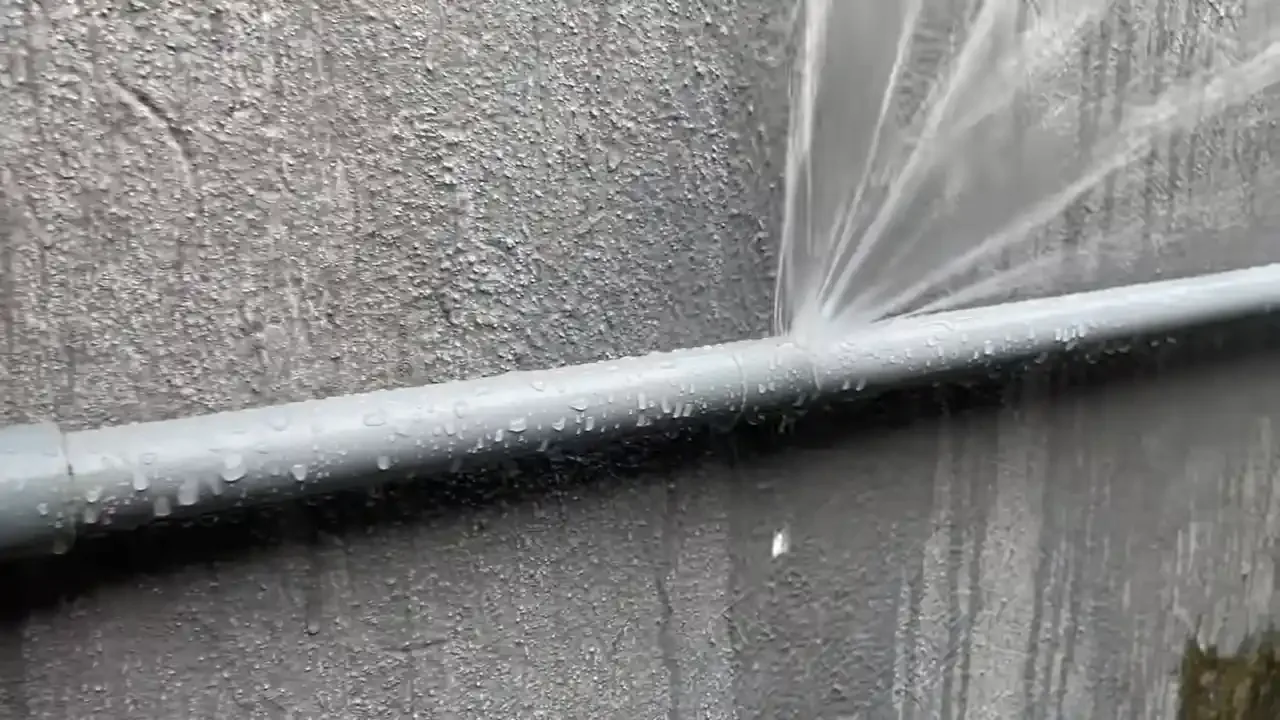
The Pinhole Leak Problem in Pueblo's Mid-Century Housing Stock
A pinhole leak is exactly what the name suggests: a small perforation in a copper pipe wall, often less than a sixteenth of an inch wide. The hole itself is modest. The damage it causes over weeks and months inside a closed wall cavity is not.
In Pueblo County, pinhole leaks concentrate in homes built from 1965 to 1985, the copper-era construction in Belmont, Lakeview, Country Club, Sunset Park, and Regency Park. These supply systems are now 40 to 60 years old and entering the active failure window for Pueblo's 180 mg/L hard water.
Pueblo Water's Whitlock treatment plant produces 180 mg/L total hardness, 10.5 grains per gallon. At this level, mineral interaction with the copper pipe's interior oxide layer gradually thins the protective coating at high-velocity points. When the layer fails at a fitting or elbow, direct electrochemical corrosion begins and the pipe wall corrodes outward until a pinhole forms.
Why Pinhole Leaks Are Difficult to Catch Early
The slow drip rate of a typical pinhole (a fraction of a gallon per hour)rarely produces an immediately visible wet surface. The water bill is the earliest signal: a quiet pinhole running continuously adds 2,000 to 4,000 gallons per billing cycle to the Pueblo Water meter reading, showing up as a 15 to 30 dollar monthly increase before any stain appears.
By the time a ceiling stain appears in a Country Club or Lakeview home, the wall cavity has been wet for days to weeks. The pipe repair is straightforward; the drywall, insulation, and potential mold remediation drive the total cost. Detection at the water bill signal keeps the scope to the pipe itself.
Early detection is what prevents that sequence. A professional survey with acoustic listening equipment and moisture-sensing tools finds active pinhole leaks before visible damage appears, not after.
How We Detect Pinhole Leaks in Pueblo Homes
Detection begins with a pressure test of the supply system. A static pressure drop with all fixtures off and the main valve closed confirms an active leak somewhere in the line. That narrows the search before any listening equipment is deployed.
Acoustic detection locates the leak within the wall or ceiling cavity. Probes placed on framing members or drywall surface pick up water escaping under pressure, with signal strength peaking at the failure point. Thermal imaging cross-checks the acoustic location before any access cut is made, two independent confirmations before the wall opens.
When the leak is between floor joists or inside a ceiling cavity with limited contact access, electronic amplification supplements acoustic listening, signal processing distinguishes leak noise from ambient building sounds and narrows the location before any access is made.
Repair Options: Spot Repair vs. Repipe
Spot Repair for Isolated Failures
When detection confirms a single active pinhole in an otherwise sound copper system, a spot repair is appropriate: the wall is opened at the confirmed location, the failed section is replaced, and the wall is patched. The total scope is one opening, one pipe section, one repair, if detection was accurate.
Whole-House Repipe for Systemic Failure
When a home has had two or more pinhole leaks within a few years, or detection finds thinning at multiple points, a spot repair on the current event leaves the adjacent pipe (at the same corrosion stage)to fail next. The correct decision at that point is repipe assessment, not another patch.
A whole-house repipe replaces all supply lines with PEX. PEX does not corrode in response to Pueblo's hard water chemistry and does not develop pinholes. It eliminates the failure mechanism rather than patching around it.
Most Belmont and Lakeview homeowners who reach a third pinhole event find the repipe economics favorable: cumulative repair and remediation costs from recurring events typically exceed the repipe investment within two cycles.
Pinhole Leaks and Pueblo's Water Chemistry
The Pueblo Board of Water Works draws supply from the Arkansas River and Continental Divide snowmelt. The resulting 180 mg/L hardness comes from dissolved calcium and magnesium carbonates in the upper watershed limestone geology.
Hard water accelerates pinhole formation at velocity-transition points, elbows, tees, and fittings where turbulence strips the interior oxide layer faster than in straight runs. This is why pinholes in Pueblo County copper homes cluster at fittings, not in mid-run sections, and why the failure rate rises sharply as systems pass the 40-year mark in continuous hard water exposure.