
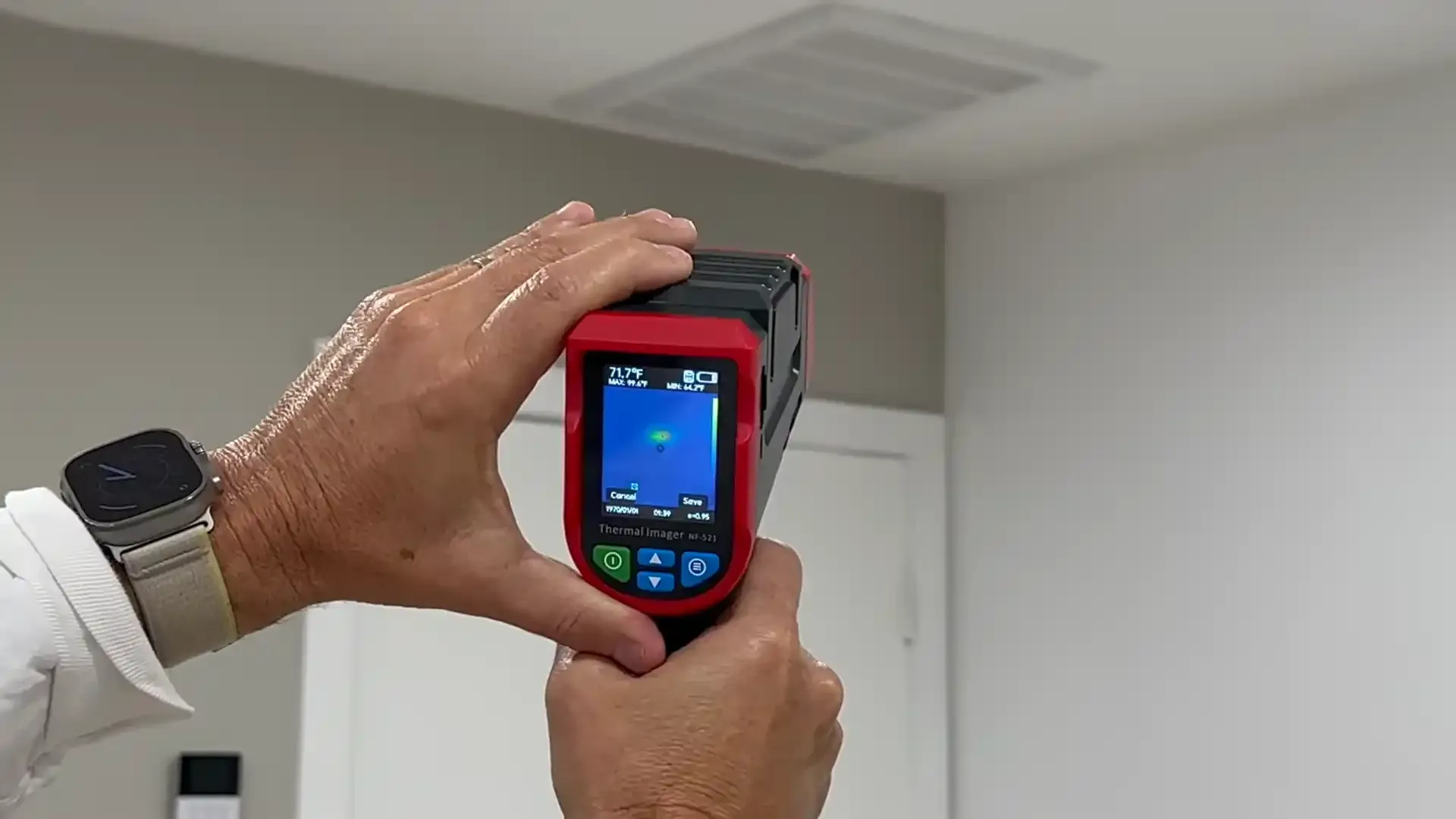
How Thermal Imaging Detects Hidden Leaks
Every object emits infrared radiation in proportion to its temperature. An infrared camera (a thermal imager)captures this radiation across a wide field of view and converts it to a false-color temperature map that the operator reads in real time. Where a surface is uniformly one temperature, the thermal image is uniformly one color. Where a leak introduces water at a different temperature from the surrounding structure, warmer, from a hot water supply failure, or cooler, from a cold water line leak adjacent to warm surroundings: the temperature anomaly appears as a distinct zone on the thermal image.
The detection depends on a temperature differential between the leaking water and the surrounding structure. A hot water supply line pinhole in a wall of a Belmont or Country Club home produces a warm zone on the drywall surface that may be 2 to 5 degrees Fahrenheit warmer than the adjacent drywall. That differential is well within the sensitivity range of modern thermal cameras, professional-grade imagers resolve temperature differences of 0.05 degrees Fahrenheit or less. A cold water line failure in a warm basement produces the opposite: a cool zone on the floor or wall surface above the leak point.
Thermal Imaging in Practice: What Operators Look For
The operator scans wall, floor, and ceiling surfaces methodically, reviewing the thermal image in real time for temperature anomalies that do not correspond to known structural features. A uniform warm zone on a wall that cannot be explained by insulation variation, a heating duct, or a sun-facing exposure indicates a hot water line source. The shape of the anomaly provides information about the failure: a discrete spot corresponds to an active drip or pinhole; a diffuse warm zone spreading downward indicates water traveling along framing before accumulating at a low point.
Thermal imaging is particularly effective for slab leak detection of hot water line failures. A hot water supply line failing under a concrete slab in a Pueblo County home warms the concrete directly above the leak point. The thermal camera scanning the floor surface detects this warm zone as a distinct patch against the background floor temperature. The anomaly boundary maps the extent of thermal influence, typically within 12 to 18 inches of the actual leak location, allowing acoustic confirmation to narrow to the precise repair point.
Thermal imaging requires a temperature differential to function. For cold water line leaks, effective thermal detection requires the room to be at a noticeably warmer temperature than the supply water, which in Pueblo County is typical except during winter months when cold supply water and cold indoor temperatures converge. Hot water line failures are reliably detectable year-round.
Combined Thermal and Acoustic Detection in Pueblo County
Thermal imaging and acoustic detection are complementary methods used together for maximum reliability. Thermal imaging covers area quickly and identifies zones of interest, a 1,500 square foot floor can be thermally scanned in 10 to 15 minutes. Acoustic probing then concentrates on the thermally identified zones to pinpoint the leak to within a few inches. This two-method approach reduces total detection time while improving location accuracy, and it is the standard approach for slab leak detection in Pueblo County's mid-century copper-era homes across Belmont, Country Club, and Lakeview.
For in-wall pinhole detection, particularly in Pueblo County homes where the wall cavity configuration makes acoustic probe placement difficult, thermal imaging provides the initial zone identification that allows acoustic work to be targeted rather than systematic. Call (303) 552-3896 for thermal imaging leak detection throughout Pueblo County.