
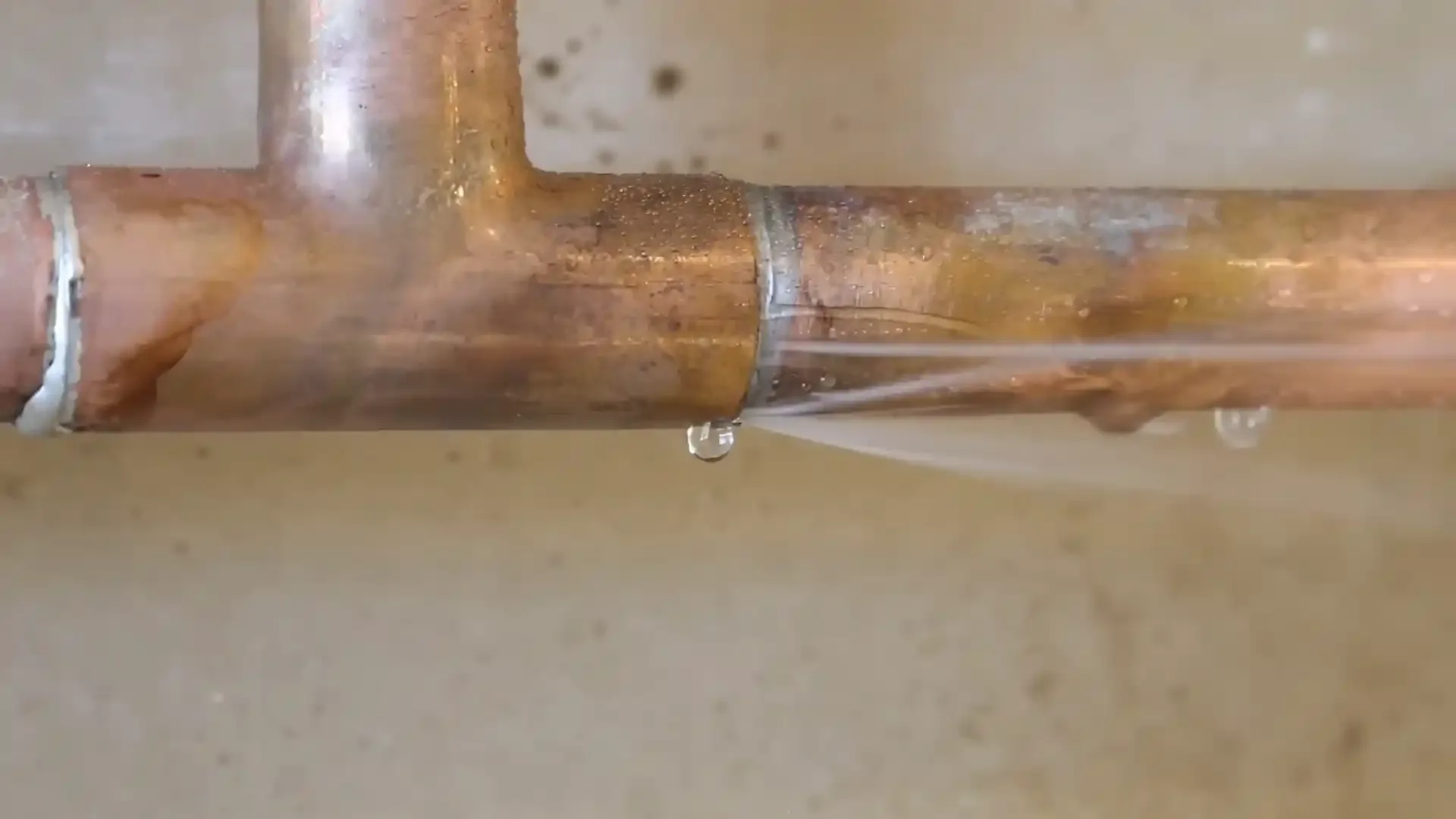
The Uncomfortable Math for Pueblo County Copper Homes
If your Pueblo County home was built between 1965 and 1995 with copper supply lines, which describes virtually every home in Belmont, Lakeview, Country Club, Highland Park, Sunset Park, Regency Park, University Park, and dozens of streets throughout the city: the pipe in your walls has been in contact with Pueblo Water's 180 mg/L hard water for 30 to 60 years. The corrosion that produces pinhole leaks has been progressing throughout that time, whether or not a failure has yet surfaced.
This is not a catastrophist prediction. It is the straightforward engineering reality of aging copper in moderately hard water, applied to the specific age and water chemistry context of Pueblo County's mid-century housing stock. Understanding the mechanism helps homeowners make better decisions about when to act, rather than waiting for a leak to announce itself through a wall stain or a flooded room.
Why 20 Years Is the Threshold
Copper pipe's protective interior oxide layer: the cupric oxide coating that keeps the pipe wall from direct contact with water, develops and stabilizes in the first few years of service. In clean, neutral, or soft water, this layer remains intact essentially indefinitely. In moderately hard water like Pueblo's supply, the layer begins to develop irregularities over years of mineral interaction, particularly at fittings, elbows, and transitions where water velocity increases and the turbulence strips the coating more aggressively.
At the 20-year mark, these irregularities are developing. At 30 to 35 years, the first pinholes begin to appear at the most-stressed coating locations. At 40 to 55 years, where most of Pueblo County's copper housing stock now sits: the failure rate accelerates. The reason is cumulative: each year of additional hard water exposure adds to the corrosion depth at existing thin spots, and the thin spots multiply as additional fittings reach their corrosion threshold.
What "Almost Inevitable" Actually Means
The claim in the title requires honest qualification. Not every Pueblo County copper home will develop pinholes at the same time, and some properties with favorable installation conditions, fewer fittings, more gradual flow transitions, some degree of water softening, may see failures appear later in the aging curve. "Almost inevitable" means that the statistical failure rate in the Pueblo County copper-era housing cohort is high enough, and the mechanism well-understood enough, that treating it as a surprise when it happens misses the opportunity for proactive management.
A Belmont homeowner whose copper was installed in 1975 and has not yet experienced a pinhole event should not read that as evidence the pipe is exempt. It likely means the first failure has not yet broken through the pipe wall at the thin spots that are already developing. The pipe is aging; the process is ongoing.
What You Can Do Now
Monitor the Water Bill Monthly
The water bill from the Pueblo Board of Water Works is the earliest available signal of an active hidden loss. A bill that has increased 15 to 25 dollars per month with no corresponding change in household water use is worth investigating immediately, before a visible stain appears, while the wall cavity is still relatively dry and the access scope is minimal.
Get a Pressure Test and Acoustic Survey
A static pressure test, observing whether the supply system holds pressure with all fixtures off, confirms whether an active leak exists anywhere in the system. If it does, acoustic detection locates it before any wall is opened. This is the appropriate response to a bill signal, to a Pueblo County home that has had prior pinhole events, or to any copper home over 40 years old where the owner wants to know the current status of the supply system.
Have the Repipe Conversation Honestly
For Pueblo County copper homes that have had two or more pinhole events, the repipe conversation deserves a clear economic comparison: the cumulative cost of recurring spot repairs, remediation for the damage each event causes, and the ongoing uncertainty of when the next failure will occur, compared against the upfront cost of a whole-house repipe with PEX that eliminates the corrosion mechanism entirely. In most multi-event copper homes in Belmont, Lakeview, and Country Club, the economics favor the repipe. Call (303) 552-3896 for an honest assessment of your Pueblo County home's copper supply system.
How to Know Where Your Pueblo Home Falls in the Risk Timeline
The corrosion timeline for copper in Pueblo County's hard water is not uniform, it depends on the specific installation, the number of fittings in the supply runs, the water velocity patterns in the system, and whether any water treatment has been applied in the home. But for the majority of Pueblo County copper-era homes with standard installations and no water softening, the failure window falls between 35 and 60 years of service. Homes built in 1975 are now at 50 years. Homes built in 1985 are at 40 years. Both are in the active phase.
| Neighborhood | Build Era | Copper Age (2025) | Risk Level | Common Failure |
|---|---|---|---|---|
| Bessemer, Mesa Junction | 1890s–1950s | Galvanized era (pre-copper) | Galvanized failure | Scale, corrosion breach |
| Highland Park, Eastwood Heights | 1948–1962 | 63–77 years | Very High | Early copper pinholes, galvanized joints |
| Country Club, North Side | 1960–1975 | 50–65 years | Very High | Copper pinholes at fittings, slab leaks |
| Belmont, Lakeview, Sunset Park | 1965–1985 | 40–60 years | Active failure zone | Pinhole events, slab leaks, corrosion |
| Regency Park, University Park | 1975–1990 | 35–50 years | High , entering window | First pinhole events beginning |
| Aberdeen, Pueblo West | 1990–2010 | 15–35 years | Low–Medium | PEX fitting failures, irrigation |
Copper failure window accelerated by Pueblo Board of Water Works' ~180 mg/L hardness vs. national average ~100 mg/L. Homes in the 40–65 year range are in the highest-probability zone for active pinhole events.
The diagnostic tool that gives you a real-time status check on any copper system regardless of age is the static pressure test. Close every fixture in the house. Take a meter reading at the Pueblo Water street meter. Wait exactly 15 minutes with no water use of any kind. Take a second reading. If the readings match, the system is holding pressure, no active loss. If the second reading is higher, water is moving through the system with all fixtures closed. The difference in readings, multiplied by 4, gives you the approximate gallon-per-hour loss rate. Even a small movement (one or two cubic feet per hour)confirms a slow pinhole somewhere in the supply system.
The Decision at the First Event: Patch or Assess
The first pinhole leak in a Pueblo County copper home is a decision point, not just a repair event. The repair itself is straightforward, acoustic detection locates it, one wall section is opened, the failed pipe segment is replaced. But the copper system surrounding that repair is at the same age and corrosion exposure as the pipe that just failed. The question the homeowner faces is: does this repair address a truly isolated failure, or is it the first visible event in a system that is beginning to fail throughout its length?
An honest assessment at the first event requires knowing how many fittings are in the supply runs, whether any prior pinholes occurred and were repaired without the homeowner's full awareness, and whether any staining in the crawlspace or basement walls suggests prior slow losses. A plumber who does detection and repair on the single event without addressing this question is doing a technically complete job. A plumber who also gives you an honest assessment of the surrounding system's condition is giving you what you actually need to make a long-term decision. Call (303) 552-3896, we detect, repair, and give honest repipe assessments for Pueblo County copper-era homes.
Pueblo County Leak? Call Now.
Acoustic and thermal detection locates it first. Same-day dispatch, 24/7.
(303) 552-3896. Call Now