
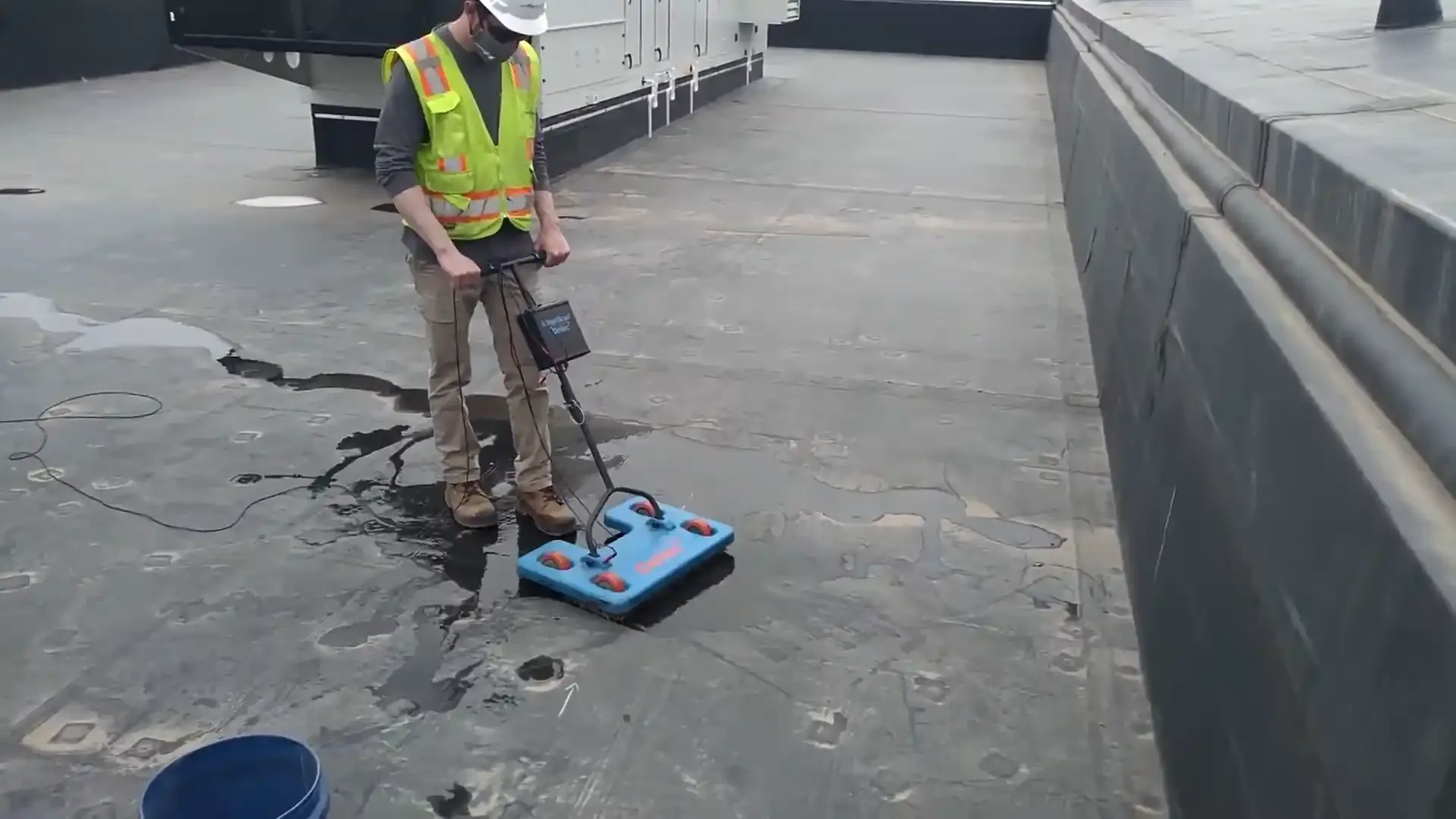
What Electronic Leak Detection Adds Beyond Basic Acoustic Listening
Standard acoustic leak detection relies on a contact probe transmitting the leak's acoustic signal to the operator's ear through headphones. This approach works well in quiet environments with favorable transmission conditions: a residential slab in an unoccupied home, a yard in the early morning before traffic builds, a wall in a room with no HVAC running. When conditions are less favorable: a thick reinforced concrete slab, dense clay soil with high acoustic attenuation, or a commercial building with active mechanical systems: the leak signal may be present but too weak or too masked by ambient noise to be reliably located through passive listening alone.
Electronic leak detection adds a layer of signal processing between the contact probe and the operator. The probe's raw signal is fed into an electronic amplifier that boosts the received signal by a controlled factor (typically 20 to 60 decibels)bringing a weak leak signal to an audible and analyzable level. Simultaneously, bandpass filters remove frequency ranges above and below the expected leak signature, stripping away the ambient interference that makes passive listening difficult in noisy environments.
The Electronic Signal Processing Chain
The detection chain begins with a contact probe placed against the surface above the suspected leak zone, floor, wall, or ground surface. The probe element converts mechanical vibrations from the surface into an electrical signal. That signal passes through a preamplifier stage that provides the initial gain without introducing significant noise of its own. The amplified signal then enters the filter stage, where adjustable bandpass settings allow the operator to focus on specific frequency ranges.
The filtered and amplified signal reaches the operator through headphones and a visual display. The display typically shows signal amplitude across the filtered frequency range, peak amplitude at a given probe position correlates with proximity to the leak source. As the probe is moved in a grid pattern across the surface, the amplitude readings map a gradient that points toward the leak center. The location of peak amplitude is where concrete or floor access should be opened for repair.
The value of electronic amplification is not just sensitivity, it is the ability to work in conditions where passive acoustic listening would produce inconclusive results. An operator who can only use passive listening must wait for ideal quiet conditions or simply accept uncertain results in challenging environments. Electronic processing makes detection viable in Pueblo County commercial buildings during operating hours.
Electronic Detection in Pueblo County's Challenging Conditions
Thick Slab Applications
Pueblo West and newer North Side Pueblo construction from the 1990s and 2000s sometimes used heavier concrete slab pours than the thinner slabs typical of 1960s and 1970s construction. A slab that is 5 or 6 inches thick with welded wire reinforcement attenuates the acoustic signal from a slab leak more than a standard 4-inch residential slab. Electronic amplification compensates for this additional attenuation, making slab leak detection viable without the need for more invasive assessment.
Clay Soil Underground Applications
Pueblo County's bentonite clay soils, particularly in the East Side, Boone, and Avondale areas, have higher acoustic attenuation coefficients than sandy or loam soils. A buried pipe failure at 3 feet of depth in dense clay produces a weaker surface signal than the same failure at the same depth in sandy soil. Electronic amplification addresses this directly, allowing ground probing to detect buried failures in clay-heavy areas with the same reliability available in sandier soil conditions.
Commercial Building Detection
Downtown Pueblo's commercial properties: the historic retail and office buildings along Main Street and Union Avenue, operate with active HVAC, refrigeration systems, and foot traffic that create a high ambient noise floor. Electronic filtering removes HVAC frequencies and isolates the leak signal band, allowing detection work during business hours rather than requiring after-hours access. Call (303) 552-3896 for electronic leak detection throughout Pueblo County.