
The Billing Error Theory Is Almost Always Wrong
When a Pueblo homeowner opens a water bill from the Pueblo Board of Water Works that is 40, 60, or 100 percent higher than last month, with no guests, no pool filling, no irrigation changes, the first instinct is often to call the utility and report a billing error. That call rarely changes the bill. The Pueblo Board of Water Works meters water at the street with accurate electronic meters that record gallons consumed, not dollars, errors at the meter are uncommon. When the bill doubles, something consumed that water.
The more productive first step is the meter test. Locate the water meter at the street-side box near the curb. With all fixtures in the house turned off, every faucet, toilet, appliance, and irrigation valve closed. Observe the meter dial or digital display for 3 to 5 minutes. If the meter needle moves or the digital reading changes with everything off, water is leaving the system somewhere between the meter and the fixtures. You have an active leak.
What a Hidden Leak in Pueblo Looks Like
The defining characteristic of a doubled water bill with "nothing looking wrong" is that the leak is in an enclosed space, inside a wall cavity, beneath a concrete slab, in a buried service line, or inside a toilet tank that silently drains into the bowl. None of these failure types produce visible water on the floor or obvious dripping. They lose water continuously into spaces that absorb it or drain it without producing a surface signal.
In Pueblo County, three failure types account for the majority of these hidden losses in the housing stock that produces the most service calls.
Pinhole Copper Leaks in Belmont, Lakeview, Country Club, and Similar Neighborhoods
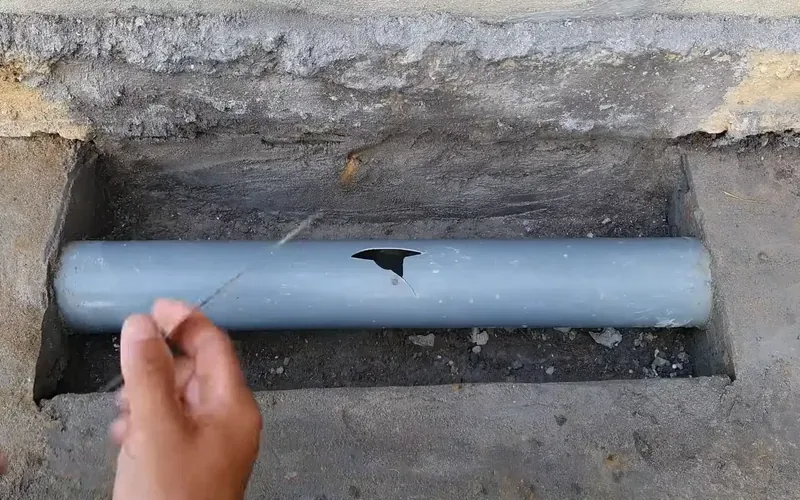
The copper supply lines in Pueblo's mid-century neighborhoods (installed between roughly 1965 and 1985)are now 40 to 60 years old. Pueblo Water's 180 mg/L total hardness accelerates copper corrosion, and these systems are in the primary pinhole failure window. A pinhole in a hot water supply line inside a wall loses water into the wall cavity continuously, 24 hours a day, at whatever the household line pressure is, typically 55 to 75 PSI in Pueblo city service. The cavity absorbs the moisture initially; the meter records every gallon.
Slab Leaks in Slab-on-Grade Homes
Ranch-style homes in Belmont, Lakeview, Country Club, Sunset Park, and Regency Park are frequently built slab-on-grade with supply lines embedded in or passing through the concrete foundation. A slab leak loses water into the soil beneath the slab under full line pressure. There is no wall to show a stain, no floor drain to collect the water, it simply saturates the soil below and the meter records the loss.
Silent Toilet Tank Leaks
A failed flapper valve in a toilet tank allows tank water to seep continuously into the bowl and down the drain. A single toilet losing water at a moderate rate can add 3,000 to 6,000 gallons per month to the bill without producing any sound. The dye test confirms it in 15 minutes: add food coloring to the tank, wait without flushing, and check whether color appears in the bowl. If it does, the flapper is failing.
After the Meter Test: What to Do
If the meter test confirms movement with all fixtures off, the next step is narrowing the location. Close the main interior shutoff (typically near where the service line enters the house). If the meter stops moving, the leak is inside the house, a toilet, a wall supply line, or a slab leak. If the meter continues moving with the interior shutoff closed, the leak is in the exterior service line between the meter and the house shutoff.
Do not wait for a stain to appear before calling for acoustic detection. The longer a hidden leak runs in a Pueblo County home, the more moisture accumulates in wall framing, insulation, and subfloor materials, which adds remediation cost to the repair bill. Detection at the bill-increase stage, before visible damage, consistently produces a lower total cost than detection after the wall stain appears.
Call (303) 552-3896 for same-day acoustic leak detection throughout Pueblo County. We locate hidden supply line losses, in walls, under slabs, and in buried service lines, before any surface is opened.
The Meter Test: How to Confirm a Hidden Leak in 15 Minutes
The Pueblo Board of Water Works street meter is the most accurate tool available for confirming whether a water bill increase reflects an actual loss. The test requires no equipment and takes 15 minutes. Close every fixture in the house, all faucets, the dishwasher, the washing machine, the ice maker, the irrigation system if it runs on a timer. Locate the meter box at the curb: the rectangular cover set into the ground near the street. Open it and note the current reading, or note the position of the sweep hand on analog meters.
| Leak Type | Loss Rate (approx.) | Monthly Gallons | Bill Signal |
|---|---|---|---|
| Silent flapper seep | ~0.5–1 gal/min | ~700–1,400 gal | Small increase, easy to miss |
| Running fill valve | ~2–4 gal/min (cycles) | ~1,500–3,000 gal | Noticeable increase |
| Slow pinhole (copper wall) | ~0.1–0.5 gal/hr | ~70–360 gal | Small, bill signal before stain |
| Active slab leak (hot water) | ~1–3 gal/min | ~1,400–4,300 gal | Large increase, first indicator |
| Buried service line break | ~2–10 gal/min | ~2,900–14,400 gal | Dramatic spike, bill may double+ |
| Dripping hose bib (freeze crack) | ~0.5–2 gal/min | ~700–2,900 gal | Seasonal, spring discovery |
Pueblo Board of Water Works meters residential consumption precisely. Any unexplained increase, even small, warrants a meter test before the next billing cycle. Loss rates are approximations. Actual depends on line pressure (Pueblo Water typically 55 to 75 PSI).
Wait 15 minutes without using any water. Return to the meter and check the reading again. On Pueblo Water's digital AMR meters, even a small flow (a fraction of a gallon per minute from a slow pinhole)will advance the reading measurably in 15 minutes. If the reading has not advanced, the meter is not recording consumption and there is no active loss from the supply system. The bill increase is either a Pueblo Water billing issue, a legitimate consumption increase, or a drain-side loss (which the meter does not record).
If the reading has advanced, water is flowing through the supply system with all fixtures closed. The meter movement confirms an active leak somewhere between the meter and the end of the supply distribution within the house. At this point the location question replaces the existence question, and acoustic detection is the correct next step.
Distinguishing Supply Leaks From Drain Leaks and Running Fixtures
The meter test catches supply-side leaks, failures in the pressurized supply lines from the meter to the fixtures. It does not catch drain-side leaks, which occur after water has passed through a fixture and entered the drain system. A dripping P-trap, a cracked drain pipe, a failing shower pan: none of these register on the water meter because the water that drips through them has already been measured at the meter when it was used.
A running toilet is the most common fixture event that registers on the meter without producing visible symptoms. The toilet fill valve allows water to flow continuously from the supply side into the bowl and down the drain, bypassing normal fixture use. The meter records it; the homeowner may not hear it if the fill valve is running slowly. If the meter test shows active flow with all fixtures closed, isolating the toilet as the source is straightforward: close the toilet's supply shutoff valve under the tank and recheck the meter. If the meter movement stops, the toilet was the source. If it continues, the source is elsewhere in the supply system. Call (303) 552-3896 for leak detection and diagnosis throughout Pueblo County — one call, 24/7 response.
Leak Near You in Pueblo County?
We pick up any time, day or night. Detection first, repair second, 24/7 throughout Pueblo County.
(303) 552-3896 — Call Now