
Why Copper Pipe Failure Is Concentrated in Pueblo County's Mid-Century Homes
Copper became the standard residential supply pipe material in the 1950s and remained dominant through the early 1990s. In Pueblo County, this means the Belmont, Country Club, Lakeview, Highland Park, Sunset Park, and Regency Park neighborhoods, the mid-century and 1970s–80s tract development areas that expanded as Pueblo diversified its economy after the CF&I steel mill era, contain copper supply systems that are now 40 to 60 years old.
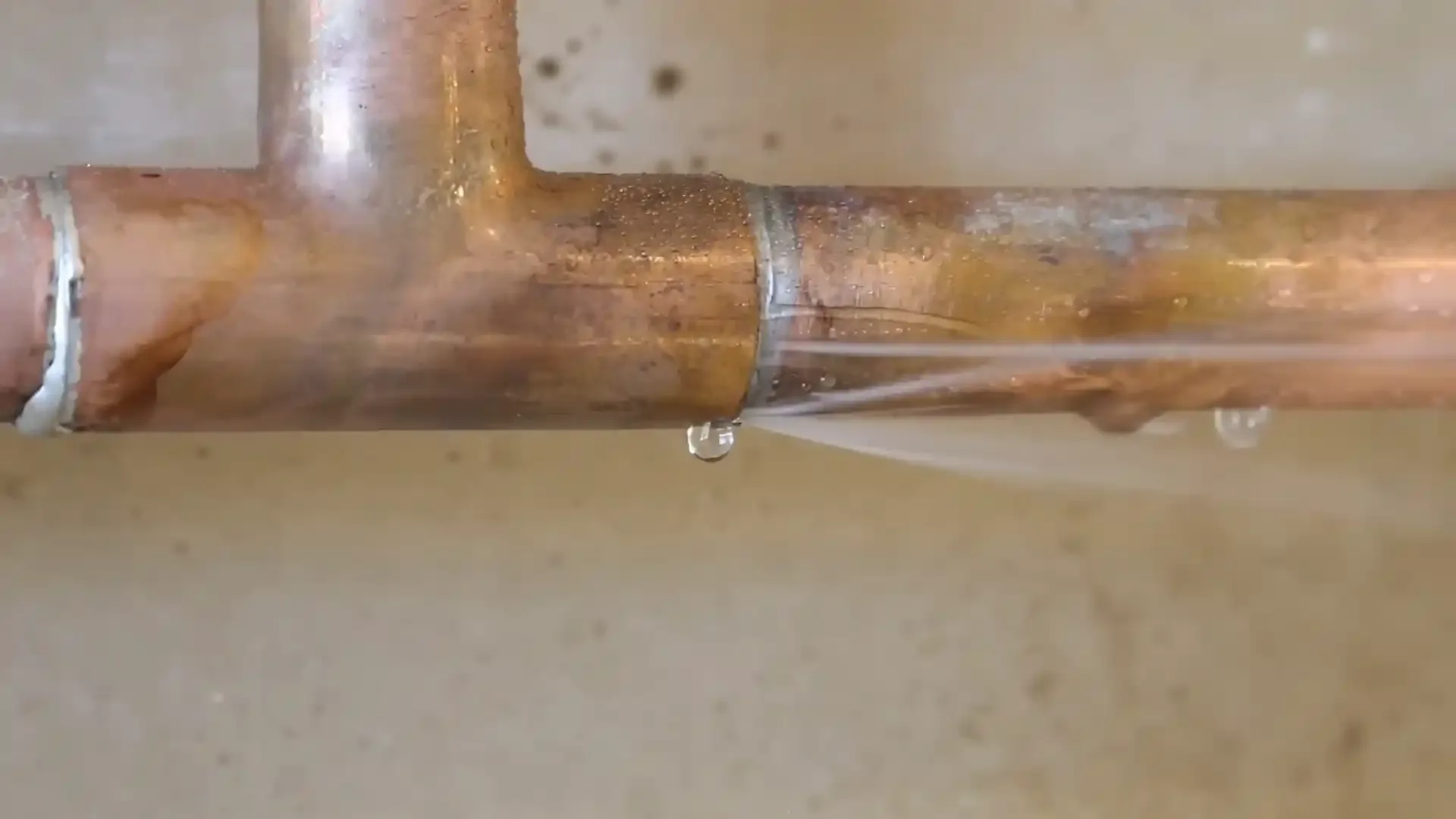
Copper's vulnerability in Pueblo County is specific: Pueblo Water's Whitlock treatment plant produces water averaging 180 mg/L total hardness, 10.5 grains per gallon. Hard water carries elevated calcium and magnesium bicarbonates. As this water passes through copper pipe daily, it interacts with the interior cupric oxide protective coating. The interaction is not uniform: at fittings, elbows, and points of turbulence where water velocity increases, the oxide layer thins faster. When it thins to zero, the underlying copper corrodes outward. The result is the pinhole leak: a tiny perforation that loses water slowly but continuously into whatever space it occupies.
The failure timeline is predictable. Copper pipe in Pueblo County shows elevated pinhole rates beginning around the 35-year mark and accelerating through the 45 to 55 year range. Most of Pueblo's Belmont and Lakeview housing stock is now in that window. A system that had one pinhole repair two years ago is statistically likely to develop another within the next two years, not because the repair failed, but because the surrounding pipe is at the same corrosion stage.
Detecting Copper Pipe Leaks in Pueblo County Homes
A static pressure test is the first step. With all fixtures closed and the main valve open, a pressure gauge at a hose bib reads the static line pressure. If the pressure drops measurably over several minutes with no fixtures running, an active leak exists somewhere in the copper supply system. This distinguishes an active copper pipe failure from a drain leak or other source.
Acoustic detection then locates the failure. Listening equipment at wall surfaces, floor access points, and meter picks up the characteristic frequency of pressurized water escaping through a small copper pipe perforation. The signal differs from a slab leak, copper in-wall leaks transmit sound through both the pipe and the adjacent framing. Experienced operators distinguish the location with precision. Thermal imaging adds a layer for hot water line failures: escaping hot water creates a temperature anomaly visible through the drywall surface on an infrared camera.
For slab-embedded copper failures, common in the slab-on-grade construction of Pueblo's 1960s and 1970s tract homes, acoustic detection from the floor surface locates the failure before any concrete is opened.
Repair vs. Repipe: The Honest Assessment for Pueblo County
Spot Repair for Isolated Failures
A copper pipe with its first confirmed failure and remaining service life warrants a spot repair. The damaged section is cut out, the new section is joined with copper or PEX using press-fit or soldered couplings, and the wall is patched. This is the right call when detection confirms the failure is genuinely isolated and the adjacent pipe shows no corrosion during the access opening.
Whole-House Repipe When the System Is Failing
When a Pueblo County home has experienced two or more pinhole leaks, or when the access opening during spot repair reveals widespread corrosion pitting on the surrounding copper, the system is telling you the failure is systemic. Spot repair at the known hole leaves the failing pipe in place. A whole-house repipe with PEX eliminates the corrosion vulnerability entirely. PEX does not corrode in response to water chemistry. For Belmont and Lakeview homeowners who have been through multiple copper leak events, the repipe conversation is overdue. Call (303) 552-3896 to discuss options for your Pueblo County home.