
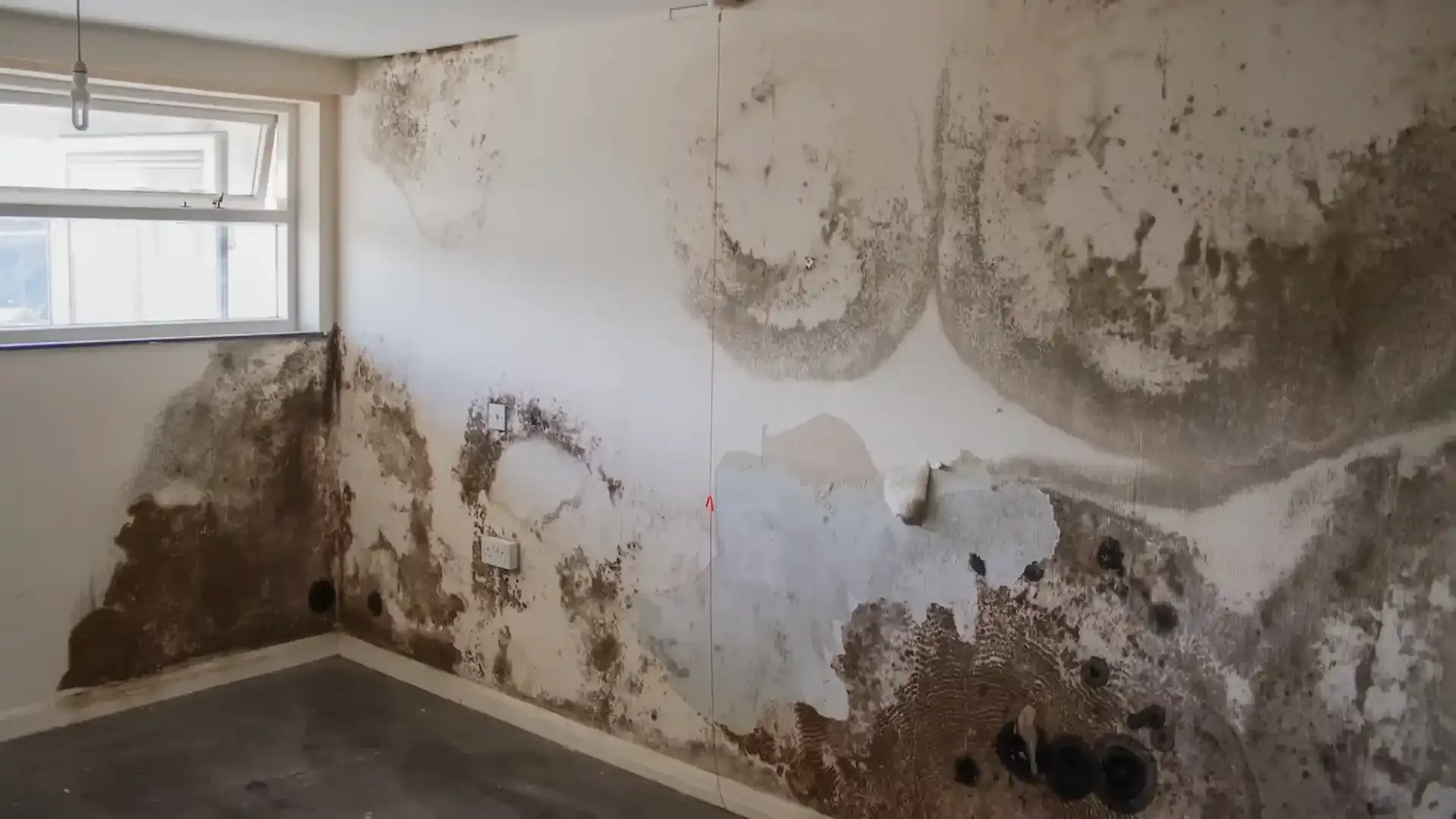
Wall Leaks in Pueblo County Homes: What's Hidden Inside
The wall cavity of a Pueblo County home is an enclosed environment with no ventilation and no drainage. When water enters it, from a pinhole in a copper supply line, a failed shower grout line, or a leaking pipe fitting. It has nowhere to go. It saturates the nearest materials: fiberglass insulation batts, wood framing studs, and the paper facing of the drywall on both sides of the cavity. Mold establishes within 24 to 48 hours in saturated conditions. Wood framing begins to lose structural integrity after sustained moisture exposure.
In Pueblo County's 1960s through 1980s housing stock, Belmont, Lakeview, Country Club, Sunset Park, copper supply lines running vertically through wall cavities are the primary in-wall leak source. These systems are 40 to 60 years old, and Pueblo Water's 180 mg/L hard water accelerates the corrosion of their interior oxide coating. A pinhole in a hot water riser running through a first-floor wall cavity toward a second-floor bathroom drips into insulation below. The insulation absorbs water until it is saturated, then the paper drywall facing below begins to wick moisture. The visible stain appears at the baseboard level, feet below the actual pinhole.
In older Bessemer, Mesa Junction, and Downtown Pueblo homes with galvanized supply lines, the failure mode is different: corrosion-thinned galvanized pipe develops a rust breach at a fitting or elbow, typically producing a faster drip that saturates the wall cavity more rapidly. The first external indication is sometimes a metallic stain or rust discoloration at the baseboard or floor junction.
Detection Without Exploratory Demolition
Acoustic leak detection is the primary tool for in-wall supply line failures. Listening equipment placed against the exterior drywall surface picks up the sound of water escaping under pressure from a small pipe opening inside the cavity. The frequency and intensity of the signal at different wall surface positions allows triangulation of the leak location to within a few inches. This precision determines exactly where to open the wall, minimizing the access cut to the repair point rather than opening a large section to search.
Thermal imaging supplements acoustic work for hot water line failures. A pinhole in a hot water supply line creates a temperature anomaly on the adjacent drywall surface, warmer than surrounding areas because hot water is escaping into the cavity. The infrared camera shows this as a distinct warm zone that maps directly to the leak location.
Moisture meters applied at multiple points on the wall surface establish the extent of wet drywall and framing. This serves two purposes: it confirms active moisture is present rather than a historic stain from a past leak, and it maps how far the moisture has spread, which determines the scope of drywall replacement after the pipe is repaired.
Knowing the extent of moisture before opening the wall prevents discovering unexpected damage mid-repair. The moisture map tells you what to prepare for before the first cut is made.
In-Wall Pipe Repair in Pueblo County
Once the leak is located, the wall is opened at the confirmed repair point. For a pinhole in a copper supply line, the damaged section is cut out and replaced with new copper or PEX. The access opening is kept minimal (typically just large enough for the pipe repair)and patched after completion.
For a galvanized pipe fitting failure in a Bessemer or Mesa Junction home, the repair decision accounts for the surrounding pipe condition. If the galvanized run is extensively corroded in the accessible section, the repair scope expands to reroute or replace the run through that wall rather than patch at a single failure point. Call (303) 552-3896 for wall leak detection and repair throughout Pueblo County, from the historic neighborhoods in central Pueblo to rural communities including Beulah, Rye, and Colorado City.