
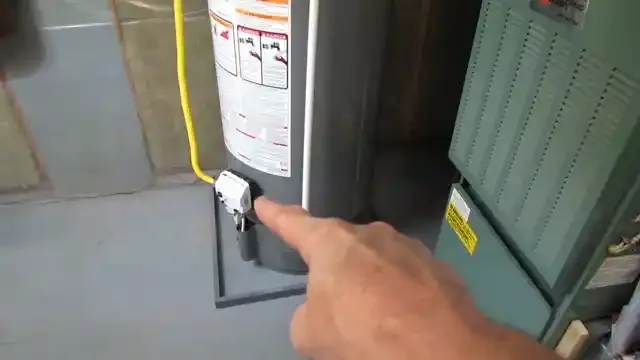
Water Around a Water Heater Is Never Normal
Water pooling beneath or around a water heater in a Pueblo County home is not condensation, is not normal operation, and does not resolve on its own. It is always a failure of some component, and identifying which component determines whether the repair is a simple part replacement or a full unit replacement. Three failure points account for the large majority of water heater leaks. Dry the unit exterior completely and observe where moisture reappears during normal operation. This diagnostic sequence identifies which failure is active without requiring disassembly.
Failure Point 1: The T&P Relief Valve
The temperature and pressure relief valve, mounted on the side of the tank near the top with a discharge pipe running downward, is a safety device that should never discharge water during normal operation. When water drips from the T&P discharge pipe, two conditions are possible: the valve is opening because actual temperature or pressure is elevated (a legitimate safety response), or the valve's internal seal has failed and is weeping continuously despite normal tank conditions.
In Pueblo County, high street-side supply pressure from the Pueblo Board of Water Works distribution system contributes to some T&P valve events. If supply pressure exceeds 80 PSI, the T&P valve operates closer to its activation threshold and opens more frequently. A pressure test at the nearest hose bib confirms whether high supply pressure is a factor. A weeping T&P valve requires replacement: the valve is an inexpensive part, but the discharge indicates a condition worth investigating before simply replacing the valve.
Failure Point 2: Connection and Fitting Leaks
The cold water inlet and hot water outlet at the top of the tank connect to household supply lines through dielectric union fittings, designed to prevent galvanic corrosion between the steel tank and copper supply lines. In Pueblo County's hard water environment, mineral scale accumulates at these connections over years of service, cracking the plastic isolating insert or corroding the union body.
A connection leak produces water dripping from the top of the unit that runs down the side and pools at the base, which can look like a tank body failure but originates higher up. Drying the tank exterior completely and observing where moisture first appears during operation distinguishes a top-connection leak from a tank body failure. Moisture appearing at the top fittings running downward is a connection repair. Moisture appearing from the tank body itself is not.
Failure Point 3: Tank Body Failure
A water heater leaking from the tank body itself, from a seam, weld line, or the drain valve area at the base, is at end of life. Tank body failures are not repairable. No patch holds on a pressurized steel tank that has corroded through its wall. The unit requires replacement.
In Pueblo County, the tank failure timeline is accelerated by sediment accumulation. Pueblo Water's 180 mg/L hard water deposits a sediment layer on the tank floor over years of service, insulating the bottom from the burner flame below. The insulated area overheats, the steel fatigues, and internal corrosion progresses faster than in a clean tank. Annual tank flushing (draining sediment from the drain valve at the base)slows this accumulation and extends tank life. A Pueblo County water heater more than 10 to 12 years old with active tank body seepage has likely reached end of life. Call (303) 552-3896 for water heater leak detection throughout Pueblo County.
Pueblo's Hard Water and Accelerated Water Heater Failure
The Pueblo Board of Water Works delivers 180 mg/L hard water to every residential meter in the city. For water heaters, this hardness level is the primary driver of accelerated tank failure. Hard water minerals (calcium and magnesium carbonates)precipitate out of solution when water is heated. The heat of the water heater tank accelerates the precipitation process, and the minerals settle to the bottom of the tank as a sediment layer.
A water heater without this sediment layer has good thermal contact between the burner flame and the tank bottom, and the heat is transferred efficiently to the water above. A water heater with a thick sediment layer has an insulating material between the burner flame and the tank. The burner runs longer to achieve the same water temperature, the tank bottom overheats trying to push heat through the insulation, and the steel fatigues. Internal corrosion accelerates in the overheated zone. The tank fails from the bottom up, which is why tank body failures in hard water markets like Pueblo typically occur at the drain valve area or the tank bottom seam rather than at the top or side connections.
Annual tank flushing, connecting a hose to the drain valve at the base and flushing until the water runs clear, removes the accumulated sediment before it becomes an insulating layer. A Pueblo County water heater that has never been flushed accumulates sediment throughout its entire service life. A unit flushed annually maintains better thermal contact and extends the tank's useful life in Pueblo's hard water environment.
Water Heater Replacement Considerations for Pueblo County Homes
When a Pueblo County water heater has reached tank body failure, active seepage from the tank body itself rather than from connections or the T&P valve. Replacement is the correct response. Repair is not an option for a pressurized tank that has corroded through its wall. The questions at that point are: what size and type replacement is appropriate, and what additional work is needed at the installation point.
Tank sizing in Pueblo County homes follows standard household demand guidelines: 40-gallon tanks for one to two person households, 50-gallon for three to four persons, larger for families of five or more. The more important consideration in Pueblo is the connection quality at installation. Replacing the tank without replacing the dielectric unions: the fittings that prevent galvanic corrosion between the steel tank and the copper supply lines — installs the new unit on fittings that have already been accumulating hard water mineral scale for the life of the previous tank. New dielectric unions at installation give the replacement unit a clean start on the connection points most vulnerable to hard water corrosion. Call (303) 552-3896 for water heater leak detection and assessment throughout Pueblo County.
Water Leak in Pueblo County?
One call picks up 24/7. We find it before we open anything.
(303) 552-3896 — Call Now