
The 180 mg/L Number in Context
The Pueblo Board of Water Works publishes its annual water quality report with a total hardness measurement of approximately 180 milligrams per liter, 10.5 grains per gallon. The US Geological Survey classification system places this at the upper boundary of the hard category, at the threshold between hard (121–180 mg/L) and very hard (above 180 mg/L). That number alone is not alarming, many US cities have water in this range. What makes it specifically relevant to Pueblo County homeowners is the combination of this hardness level with the age of the residential copper supply systems receiving that water daily.
| City | Water Source | Hardness (mg/L) | Classification | Copper Risk |
|---|---|---|---|---|
| Pueblo | Arkansas River (Whitlock Plant) | ~180 | Hard | High , 40+ yr systems |
| Colorado Springs | Pikes Peak snowmelt blend | ~80–120 | Moderately Hard | Medium |
| Denver | South Platte / mountain snowmelt | ~60–100 | Moderately Hard | Low–Medium |
| Fort Collins | Poudre River | ~80–110 | Moderately Hard | Low–Medium |
| Grand Junction | Colorado River | ~150–200 | Hard–Very Hard | High |
| Alamosa | Rio Grande basin groundwater | ~200–250 | Very Hard | Very High |
Sources: municipal water quality reports. Hardness varies seasonally. Pueblo at ~180 mg/L sits at the hard/very-hard boundary, the highest of the major Front Range cities.
Where the 180 mg/L Comes From
The Pueblo Board of Water Works draws its supply primarily from the Arkansas River via the Continental Divide through the Frying Pan-Arkansas Project, supplemented by the Arkansas River drainage through Pueblo Reservoir. The Arkansas River picks up dissolved calcium and magnesium carbonates from the limestone and dolomite geology of the upper watershed. By the time the water reaches the Whitlock treatment plant and enters the distribution system, it carries 180 mg/L of these dissolved minerals. Treatment removes sediment, adjusts pH, and adds chloramine disinfection, but does not remove hardness minerals. The water entering your Pueblo County copper supply lines carries the full 180 mg/L load.
The Mechanism: How Hard Water Affects Copper Pipe
Copper supply pipe has a protective interior oxide layer (primarily cupric oxide)that acts as a barrier between flowing water and the copper wall. In many water chemistry environments, this layer is stable long-term. In hard water, the calcium and magnesium bicarbonate minerals interact with the oxide layer differently at different temperature and velocity conditions.
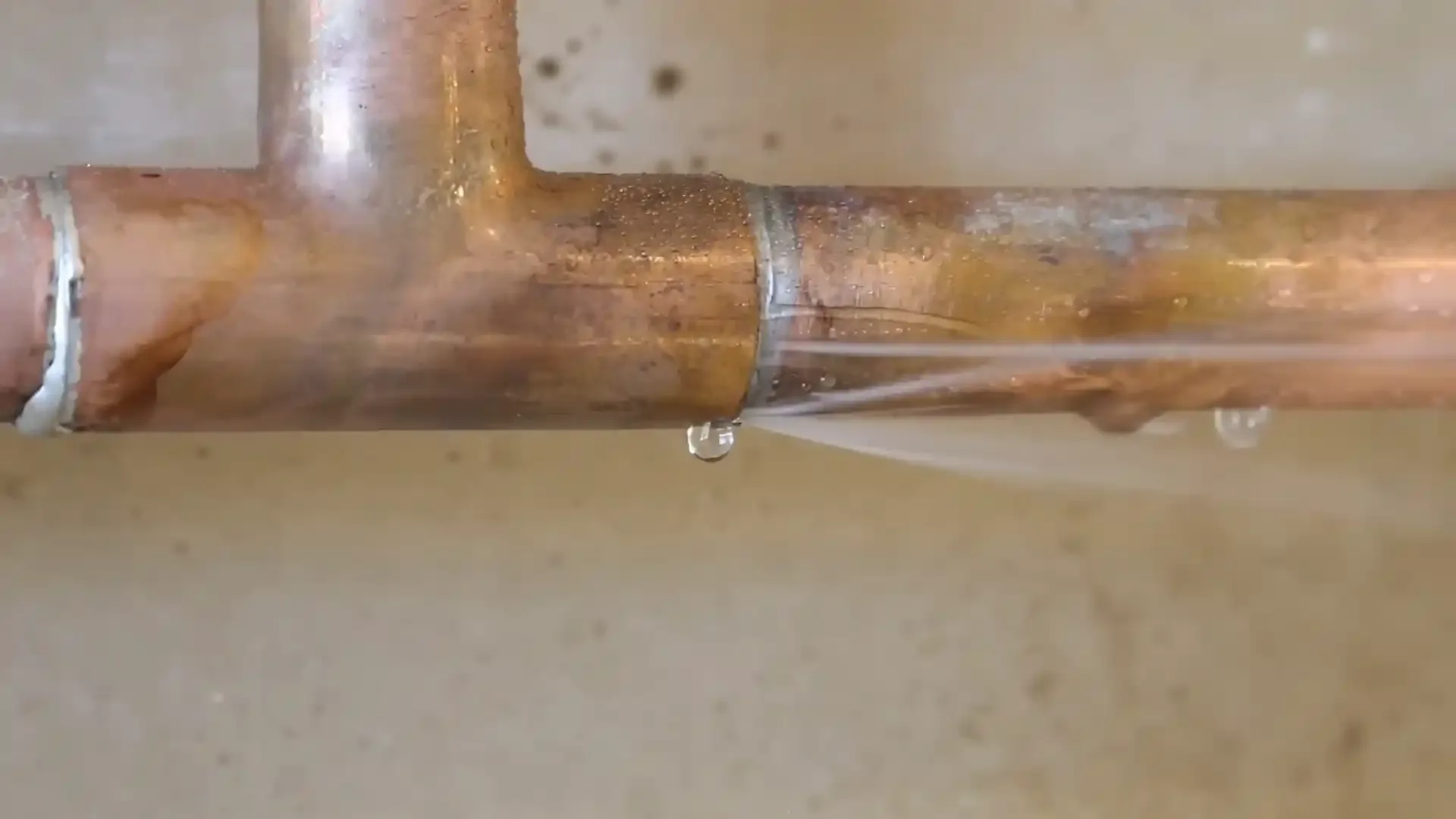
At high-velocity points, fittings, elbows, tees, and diameter changes, water carries more kinetic energy. This energy, combined with turbulence at velocity transitions, strips the oxide layer faster than in straight pipe sections with steady flow. Over years of daily water use, these high-velocity points develop thinner, more irregular oxide layers than surrounding straight sections. When the layer thins to zero at a specific point, direct electrochemical corrosion begins. The copper corrodes outward through the pipe wall, and when it breaches the full wall thickness, a pinhole appears.
This is why pinhole leaks in Pueblo County copper systems first appear at fittings and elbows, not in the middle of long straight runs. The fitting is where the oxide layer thinned first.
What 180 mg/L Means for the Timeline
The corrosion timeline varies with water chemistry, and 180 mg/L is a meaningful accelerant compared to soft-water markets. In a soft-water city at 40 mg/L, copper supply pipe may serve 60 to 80 years before first pinhole failures. In Pueblo County's 180 mg/L environment, the failure window begins closer to 35 years and accelerates through the 45 to 55 year range. For the housing stock in Belmont (built 1965–1985), Lakeview (1972–1985), Country Club (1960–1975), and similar neighborhoods, this means the pipe is in the active failure range right now. Call (303) 552-3896 for copper pipe assessment and pinhole leak detection throughout Pueblo County.
Approximate ranges based on water chemistry research. Actual timeline varies with installation quality, pipe diameter, water temperature, and fitting density.
How 180 mg/L Compares to Other Colorado Cities
Pueblo's 180 mg/L water hardness places it at the hard-to-very-hard boundary of the standard classification scale. For context, Denver Water, drawing primarily from soft mountain snowmelt through the South Platte system, typically measures 60 to 100 mg/L, well within the moderately hard range. Colorado Springs Utilities measures roughly 80 to 120 mg/L depending on the source blend. Fort Collins, drawing from the Poudre River, typically measures 80 to 110 mg/L.
Pueblo's higher hardness reflects the Arkansas River's longer transit through limestone and dolomite geology before reaching the Whitlock treatment plant. The river descends from Leadville at 10,000 feet through the Arkansas Valley, picking up minerals from the Sawatch and Mosquito ranges before arriving in Pueblo. The same geology that makes the Royal Gorge section geologically spectacular also loads the water with the calcium and magnesium carbonates that produce Pueblo's hard water character.
The practical implication for Pueblo County copper-era homeowners is that the corrosion timeline for their supply systems runs ahead of what comparable-age homes in Denver or Fort Collins experience. A Belmont home built in 1972 with copper supply is now at 53 years in Pueblo's 180 mg/L hard water: a corrosion exposure that would take roughly 80 to 90 years to accumulate in Denver's softer water. The houses are the same age. The pipe condition is not.
What You Can Do About Hard Water Corrosion in Your Pueblo Home
Water softening installed at the point of entry reduces the mineral load reaching the copper supply system. A properly sized and maintained water softener exchanges the hardness minerals (calcium and magnesium)for sodium ions through a resin bed process, producing softened water in the range of 0 to 25 mg/L that is significantly less corrosive to copper over time. For Pueblo County homes where the copper supply system is still in acceptable condition (first pinhole event has not yet occurred)a water softener installed now slows the corrosion accumulation for the remaining service life of the pipe.
For homes where the copper is already in the active failure window, two or more pinhole events, or acoustic detection showing thin points at multiple fittings: a water softener on existing pipe is addressing symptoms rather than root cause. The pipe that has already thinned will continue to fail at the existing thin points regardless of the water chemistry change going forward. In these homes, the correct sequence is repipe first to restore supply system integrity, then install a softener to protect the new pipe from the same hard water process. Call (303) 552-3896 for copper pipe assessment and pinhole detection throughout Pueblo County. We pick up 24/7 and serve all of Pueblo County and adjacent communities.
Leak in Your Pueblo County Home?
We pick up 24/7. Detection before demolition, one call, no handoff.
(303) 552-3896. Call Now