
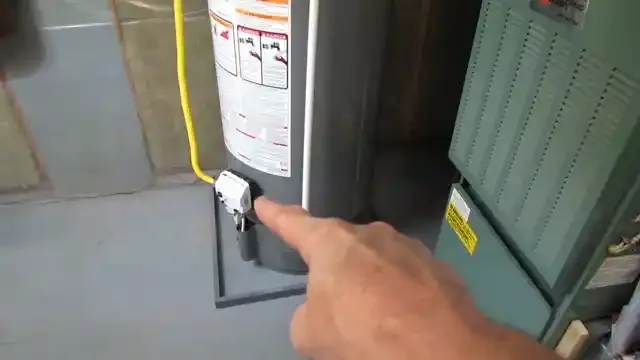
Three Failure Points: Where Water Heater Leaks Actually Come From
Water around a water heater is not always an emergency, but it is never normal and never self-resolving. The source determines the urgency and the repair path. In Pueblo County homes, water heater failures trace to one of three primary locations: the tank itself, the temperature and pressure relief valve, or the connection points at the inlet and outlet pipes.
Tank Corrosion and Internal Failure
A standard tank water heater is designed to last 8 to 12 years under normal conditions. Pueblo's moderately hard water at 180 mg/L accelerates sediment buildup on the tank floor, that sediment layer insulates the bottom of the tank from the burner flame, causes the metal to overheat, and promotes internal corrosion. When the tank itself fails, the leak appears at the bottom of the unit, sometimes as a seep along the tank seam, sometimes as active dripping from the drain valve area. A tank that is actively leaking from the body cannot be repaired. It requires replacement.
The timeline for water heater failure in Pueblo County is compressed relative to softer-water markets. Homeowners in Belmont, Lakeview, and Country Club who installed a standard 40 or 50 gallon tank heater in the early 2010s are in the window where tank inspection is warranted, particularly if they notice discolored hot water, popping or rumbling sounds during heating, or reduced hot water recovery time.
Temperature and Pressure Relief Valve Failure
The T&P relief valve is a safety device that opens when tank temperature or pressure exceeds safe operating limits. A properly functioning T&P valve should not discharge under normal conditions. When it does, water dripping from the discharge pipe that runs down the side of the heater. It indicates one of two situations: the valve is doing its job and releasing genuinely excessive pressure, or the valve has failed and is discharging water it should not be.
In Pueblo County, high inlet water pressure from the Pueblo Board of Water Works distribution system is a contributing factor in some T&P valve discharge cases. If your street-side pressure exceeds 80 PSI, the T&P valve operates closer to its threshold continuously. A failed valve that weeps continuously needs replacement: the valve itself is an inexpensive part, but the discharge indicates a system condition worth evaluating.
Connection and Fitting Leaks
The cold water inlet and hot water outlet connections at the top of the tank use dielectric unions to prevent galvanic corrosion between the steel tank nipple and the copper supply lines. These unions can corrode at the junction, especially in Pueblo's hard water environment, and develop slow drips that appear to originate from higher up on the unit. Connection leaks are generally repairable without tank replacement by replacing the fitting and union assembly.
The drain valve at the base of the tank (a hose bib-style fitting used for flushing sediment)can also fail or be left partially open. Water at the very base of the tank from the drain valve does not indicate tank failure, though the sediment that makes draining necessary is a sign of a hard-water-accelerated aging timeline.
We identify the specific leak source before recommending repair or replacement. A connection leak and a tank seam failure require entirely different responses, and one of them means the heater is done.
Detection: Confirming the Leak Source
Detection begins by drying the heater exterior completely and observing where moisture reappears under normal operating conditions. The sequence (where the water first appears)identifies the failure point more reliably than visual inspection of a wet heater. T&P discharge pipe drips are confirmed by checking operating pressure and temperature. Tank seam leaks are confirmed by drying the full lower half and watching for moisture originating at the seam or base welds rather than from above. Connection drips originate at the top fittings and run downward.
For heaters in confined utility closets or small mechanical rooms: a common configuration in Pueblo's older Bessemer and Mesa Junction homes where space is at a premium, we use moisture meters and targeted drying protocols to distinguish heater leaks from condensation or adjacent pipe failures in the same confined space.
Repair vs. Replacement in Pueblo County
A connection or T&P valve failure on a heater with remaining service life is repaired: the component is replaced and the heater continues operating. A tank that is actively leaking from the body is replaced, there is no structural repair for a corroded tank, and a patch will not hold.
For Pueblo County homeowners facing replacement, the hard water context is worth factoring into the replacement decision. A standard tank heater in Pueblo will accumulate sediment faster than the same unit in a soft-water market. Tankless (on-demand) water heaters eliminate the sediment accumulation failure mode, though they require attention to scale buildup in the heat exchanger in hard-water applications. We discuss options relevant to your home's specific water quality and hot water demand before any replacement decision. Call (303) 552-3896 anytime, same-day water heater leak response throughout Pueblo County.