
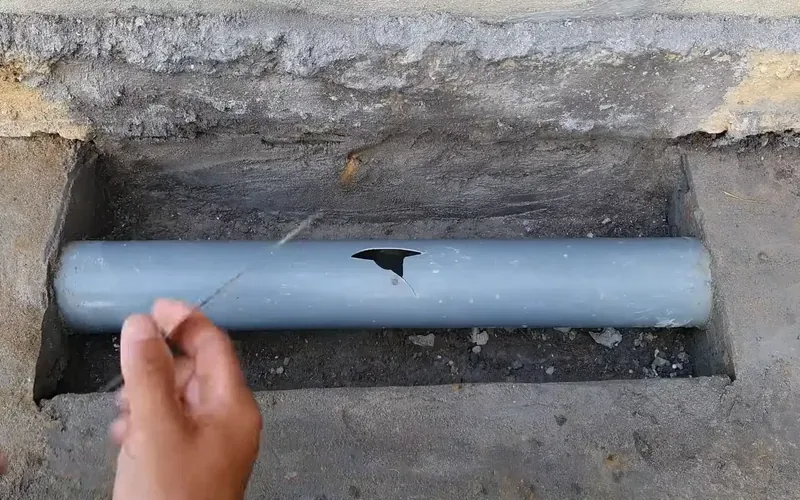
What "Plumbing Leak" Covers, and Why Detection Matters
The term plumbing leak covers many distinct failure types: a dripping supply valve under a sink, a slow seep at a drain trap connection, a pressurized supply line leak behind drywall, or a main line failure under your yard. Each has a different character, a different detection method, and a different repair path. What they share is the tendency to cause damage well out of proportion to their apparent size when left unaddressed.
In Pueblo County's aging housing stock, the range of plumbing systems in service at any given time is unusually wide. A home in Bessemer may have galvanized supply lines installed during the CF&I steel mill era of the early 1900s, pipe that is now corroding from the inside, restricting flow, and leaking at corroded joints. Two miles away in Belmont, a 1975 construction home has copper supply lines now entering the pinhole-failure window driven by Pueblo Water's 180 mg/L hard water. A newer home near University Park may have PEX with fitting failures at crimp connections.
Detection begins by establishing whether the loss is on the supply side (pressurized) or the drain side. A static pressure drop with fixtures off and the main valve closed confirms an active supply-side leak. Drain-side losses show differently, wet cabinets under sinks, staining at drain connection points, moisture in floors near shower pans. Each type of loss has its own detection toolkit.
Common Plumbing Leak Locations in Pueblo Homes
Supply Line Failures
Braided stainless or plastic supply lines connecting fixture shutoff valves to toilets, faucets, and dishwashers have a service life typically around 8 to 10 years. In homes that have not had these lines updated since original construction, common in the Country Club and Highland Park neighborhoods where homes from the 1960s and 70s may still have original supply connections: a failed line can empty a tank-equivalent volume of water in minutes. These lines fail without warning.
In-wall supply line failures from copper or galvanized pipe typically develop more slowly: a pinhole that weeps into the wall cavity for weeks before visible damage appears. Acoustic detection locates these before drywall shows the stain.
Drain and Trap Connection Leaks
Drain connections at sink traps, dishwasher drain lines, and washing machine standpipes are among the most frequently overlooked plumbing leak sources in Pueblo County homes. The compression fittings at slip-joint connections loosen over time, particularly in homes where the cabinet underneath gets regular use. A slow drain seep can saturate the cabinet floor and sub-floor for months before it reaches a level of damage that prompts a call.
Drain-side leaks don't show on your water bill, drain water is already on its way out. The only early signal is the slow accumulation of moisture in the cabinet or under the floor. By the time odor appears, mold is already established.
Fixture and Valve Leaks
A dripping faucet, a toilet that runs continuously, or a leaking shutoff valve may seem like minor nuisances, but their cumulative water waste across Pueblo County's moderately expensive utility rates adds up through the Pueblo Board of Water Works billing cycle. A toilet with a failed flapper valve can lose 200 gallons per day without producing audible running, only a water bill comparison reveals it. We identify the failing component and replace it cleanly.
Repair Across All Plumbing Leak Types
Our repair scope covers supply line replacement, in-wall pipe section replacement, drain trap and connection repair, fixture valve and supply line replacement, and repipe for systems with systemic deterioration. The detection work identifies the scope; the repair work is priced and explained before any work begins. Call (303) 552-3896 for plumbing leak detection and repair anywhere in Pueblo County, from Fountain to Cañon City, from Bessemer to Boone.