
Sewer Line Leaks in Pueblo: What Fails and Why
A sewer line leak is a breach in the drainpipe carrying waste from your home to the municipal sewer main or, in rural Pueblo County areas like Avondale, Boone, Rye, and Beulah, to a septic system. The failure can occur in the main line running under your yard, in the building drain beneath the foundation, or at connections to fixture drains within the structure.
In Pueblo's older housing stock: the historic neighborhoods of Bessemer, Mesa Junction, Downtown, Salt Creek, and Highland Park where homes were built during the CF&I Steel City era from roughly 1900 to the 1950s: the original sewer infrastructure was installed with cast iron pipe. Cast iron has a service life in the 50 to 75 year range under typical conditions. Many of these systems are now at or past that threshold. The pipe corrodes from the hydrogen sulfide gas that sewer systems produce naturally. Interior wall thinning leads to cracking and, in clay-soil neighborhoods where ground movement is active, pipe offsetting, where one pipe section shifts laterally relative to the adjacent section, breaking the joint seal.
In 1960s through 1980s construction across Belmont, Lakeview, and Country Club, ABS plastic or early PVC replaced cast iron in many buildings. These materials do not corrode, but they are susceptible to root intrusion, tree and shrub roots exploit the moisture at pipe joints, infiltrate, and eventually clog and crack the line. The mature landscaping in established Pueblo neighborhoods makes root intrusion a significant driver of sewer failures in this housing era.
Signs of a Sewer Line Leak in a Pueblo Home
Multiple slow-draining fixtures simultaneously, not just one sink, but the tub, the toilet, and the kitchen drain all sluggish at once, points to a main line problem rather than a fixture-level clog. A gurgling sound in the toilet when you run water elsewhere in the house suggests a partially obstructed or failed main line attempting to vent.
The smell of sewer gas indoors or in the yard is a direct indicator. Hydrogen sulfide has a distinctive rotten-egg odor detectable at very low concentrations. When a pipe section cracks or a joint offsets under your yard, the gas escapes through the soil. A wet or unusually green patch in the yard, particularly in Pueblo's semi-arid summer where irrigation is limited, often corresponds exactly to the pipe failure point below.
In septic-served properties in Avondale, Boone, Rye, and rural Beulah, a soggy drainfield or surfacing sewage are emergency signals that require same-day response. The Pueblo County public health implications of a septic failure add urgency beyond the property damage concern.
Any combination of slow drains throughout the house, outdoor sewage smell, and a wet yard patch warrants immediate sewer line inspection, not a wait-and-see approach.
How Sewer Line Leaks Are Detected
Camera inspection is the foundation of modern sewer line diagnosis. A waterproof camera mounted on a flexible cable is pushed through a cleanout access point in the line. The camera transmits live video showing the interior pipe condition: crack locations, offset joints, root intrusions, and collapse points. Camera inspection produces a documented finding. We can show you exactly where the failure is and what it looks like before repair work begins.
Hydrostatic testing complements camera inspection when camera access is limited or when the extent of a crack is in question. The sewer line is isolated and filled with water under controlled pressure. A drop in the water level confirms an active leak, and the camera's documented location pins the repair site. Acoustic detection is sometimes employed for surface-accessed sewer main sections.
Sewer Line Repair Options in Pueblo County
Traditional Excavation Repair
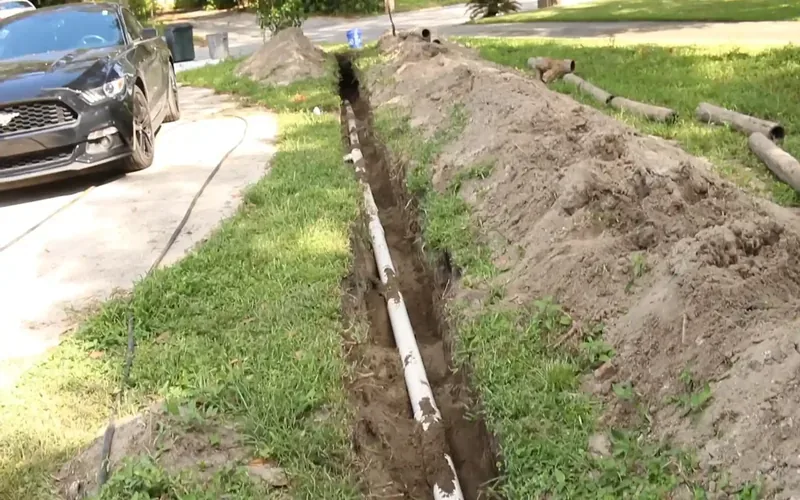
For discrete failures: an offset joint, a single crack section, a root-damaged elbow, targeted excavation at the failure point, removal of the damaged section, and replacement with new PVC or ABS is a direct and durable repair. In Pueblo's established residential neighborhoods, this typically means opening a section of yard, not a full trench.
Trenchless Pipe Lining (CIPP)
Cured-in-place pipe lining installs a resin-saturated liner inside the existing pipe, curing it to form a new pipe wall within the old one. This approach works when the host pipe is cracked but not collapsed, and when root intrusion has not created large voids. It avoids excavation entirely in most cases: the liner is installed through the existing cleanout. In established Pueblo neighborhoods with mature landscaping and concrete flatwork, this method eliminates the disruption of digging up the yard.
Full Sewer Line Replacement
When camera inspection reveals a line that is significantly deteriorated across its length, common in the oldest cast iron systems in Bessemer and the Downtown historic core. Replacement of the full run is more cost-effective than repeated spot repairs. Trenchless directional boring or traditional open-cut replacement both produce a new line from the house to the municipal connection. Call (303) 552-3896 for sewer line detection and repair anywhere in Pueblo County, including rural septic-served areas in Avondale, Boone, Rye, Colorado City, and Beulah.