
The Physics of Ultrasonic Leak Detection
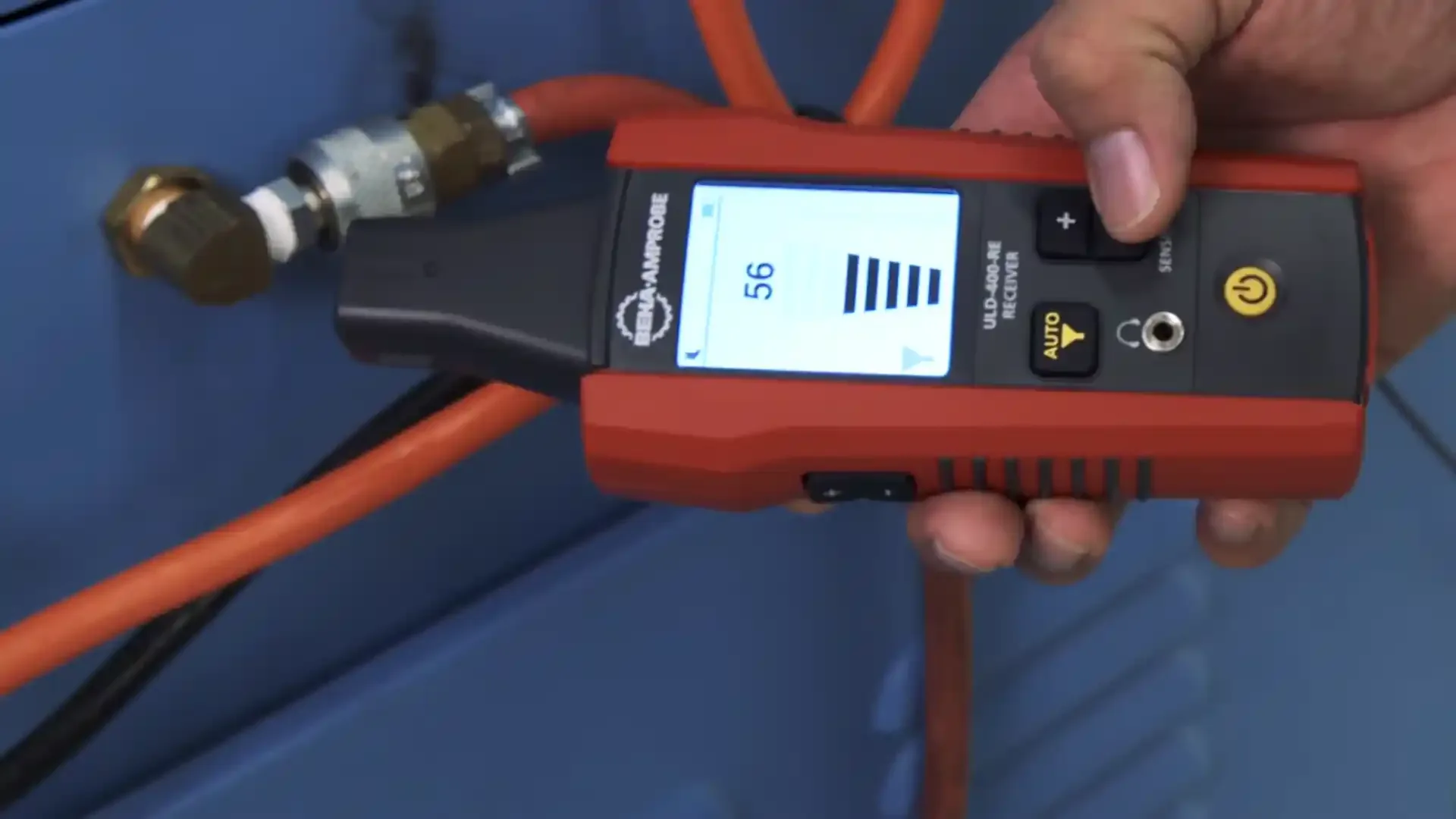
When pressurized fluid or gas escapes through a leak point, the escaping flow creates turbulence as it transitions from the high-pressure interior of the pipe to the lower-pressure environment outside. That turbulence: the chaotic mixing of fast-moving fluid with the surrounding medium, produces sound energy across a wide frequency range, including frequencies well above the 20,000 Hz upper limit of human hearing. This ultrasonic component of the leak's sound signature is the target of ultrasonic detection equipment.
The key operational advantage of working in the ultrasonic frequency range is directionality. High-frequency sound waves travel in more focused, directional beams than lower-frequency acoustic signals. An airborne ultrasonic sensor can be aimed at a surface or a suspected leak location from a distance of several feet, unlike a contact acoustic probe, which must be pressed against the surface directly. This allows systematic scanning of walls, floors, and pipe runs from a standoff position, covering area quickly before narrowing to a precise contact probe confirmation at the identified zone.
Ultrasonic Detection Equipment and Process
An ultrasonic detector consists of a directional sensor transducer, a frequency-shifting circuit that translates inaudible ultrasonic frequencies into an audible range for headphone monitoring, and a signal strength display. The sensor is pointed at the surface above the suspected leak zone and swept systematically across the area. The signal strength display peaks when the sensor is aimed at the point of highest ultrasonic emission, which corresponds to the location above the leak.
For in-wall pipe detection, the sensor is swept across the wall surface from a standoff of one to two feet. The directional beam penetrates the drywall surface and detects turbulence from a pipe failure in the wall cavity. For floor and slab applications, the sensor is aimed at floor sections from a working height. This standoff-detection capability makes ultrasonic methods faster for initial zone identification before contact probes are deployed for precise location.
Ultrasonic detection is most effective on pressurized failures that produce active turbulence. A very slow seep at near-atmospheric pressure (like a corroded valve stem weep) may not produce sufficient ultrasonic signal for reliable standoff detection, whereas a supply line pinhole at standard household pressure of 60 to 80 PSI produces a clear ultrasonic signal.
Applications in Pueblo County
Compressed and Pressurized Plumbing Systems
Pueblo County's older commercial buildings, particularly the historic structures in Downtown Pueblo and the Bessemer industrial corridor sometimes use compressed-air lines or process water systems alongside domestic plumbing. Ultrasonic detection is the preferred method for locating failures in these pressurized systems because the turbulence signal is stronger than in standard residential supply pressure ranges.
Large-Area Scanning
For a Pueblo County property where the leak location is entirely unknown: a large commercial floor area, a warehouse or light industrial space, or a multi-unit residential building where the failing circuit has not been identified. Ultrasonic standoff scanning covers area quickly. The operator moves through the space with the sensor, and signal peaks identify zones of interest for follow-up contact probe work. This reduces total detection time compared to systematic contact probing of the full area. Call (303) 552-3896 for ultrasonic leak detection throughout Pueblo County.