
What Pinpoint Leak Detection Means in Practice
Pinpoint leak detection is not a single technique. It is a commitment to location precision that shapes how detection work is sequenced and confirmed. The goal is to identify the failure location to within a few inches before any surface is disturbed. In a slab leak scenario, that means the concrete core drill is positioned at the confirmed location, not at the center of a suspected zone. In a wall leak, it means the access cut exposes the failure on the first opening rather than requiring progressive wall demolition to find the pipe.
The distinction between approximate detection and pinpoint detection has real cost consequences. A slab access opening sized for a repair (typically a 12 to 18 inch diameter core)is a minor concrete repair. A 4-foot trench opened at an estimated location, finding nothing, then extended to 8 feet before the leak is found, is a major concrete restoration project. The difference is the precision of the detection that preceded the opening.
The Multi-Method Pinpoint Protocol
Pinpoint accuracy is achieved through layered detection, using two or more complementary methods that narrow the location from a zone to a precise point.
Step 1: Zone Identification
The first detection pass establishes which section of the plumbing system contains the failure and narrows the suspected area to a zone of several square feet. For a slab leak in a Belmont or Country Club home, this might mean identifying the hot water supply circuit as the leaking circuit through pressure testing, then identifying the southwest quadrant of the living room slab as the zone of interest through thermal imaging. This first pass can cover a large area quickly and rules out large portions of the structure before detailed work begins.
Step 2: Gradient Mapping
Within the identified zone, acoustic detection probes are moved systematically at close intervals (typically 6 to 12 inches apart)while the signal amplitude is recorded at each position. The resulting amplitude gradient maps the signal strength across the zone. Signal amplitude increases as the probe approaches the leak location directly above, producing a readable peak that identifies the highest-confidence area. The peak position is marked.
Step 3: Confirmation
The marked position is confirmed using a second independent method. For a hot water slab leak, acoustic peak confirmation is cross-checked with thermal imaging: the infrared camera should show the highest floor temperature at or very near the acoustic peak position. Agreement between two independent methods at the same location confirms pinpoint accuracy. Disagreement sends the operator back through the gradient mapping step before any opening is made.
In Pueblo County's mid-century copper-era homes in Belmont, Lakeview, and Country Club, where slab leaks are most common, the two-method confirmation protocol is standard. A slab access that is drilled at the wrong location not only fails to find the repair but creates a second concrete penetration that must be patched after the correct location is finally opened.
Pinpoint Detection for Wall and Underground Leaks
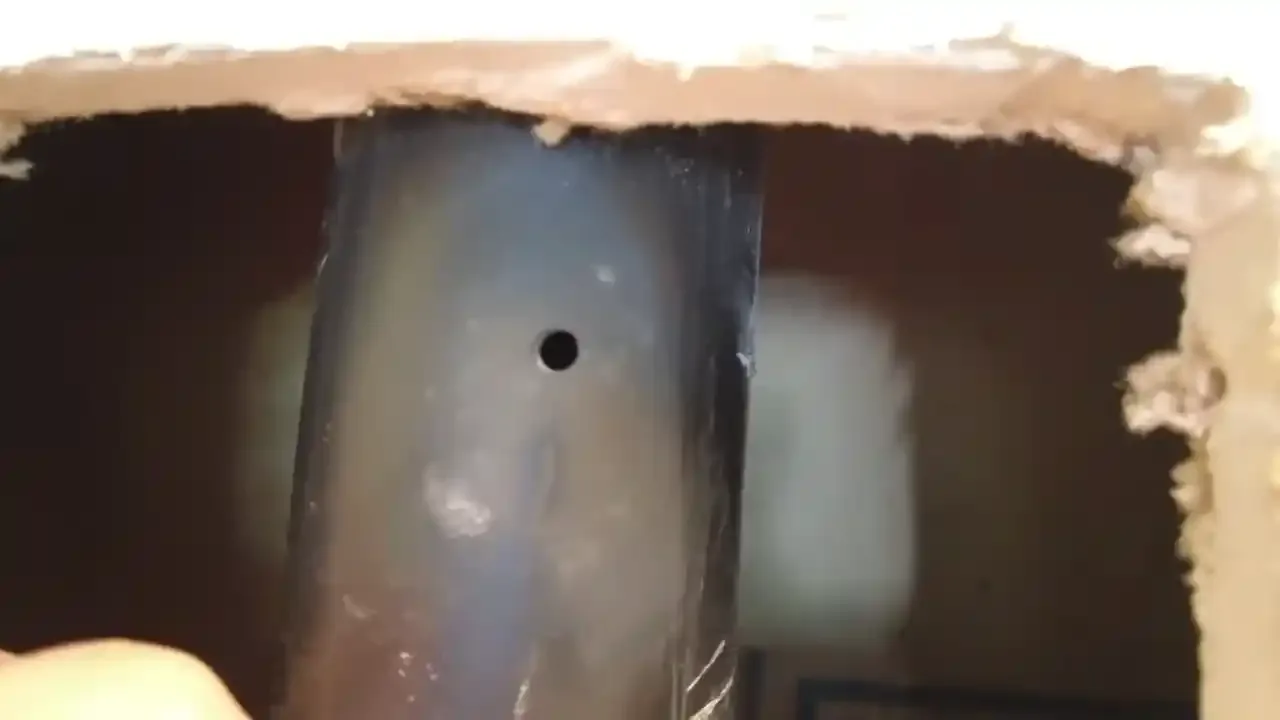
The same layered approach applies to in-wall leaks. Thermal imaging identifies a warm zone on the wall surface. Acoustic probing within that zone produces an amplitude gradient with a peak. The peak is confirmed with a moisture meter reading at the drywall surface: the highest moisture reading should align with the acoustic peak. Three independent indicators at the same location constitute pinpoint confirmation. The wall access is cut at that point, and the repair is completed without additional exploratory opening. Call (303) 552-3896 for pinpoint leak detection throughout Pueblo County.