
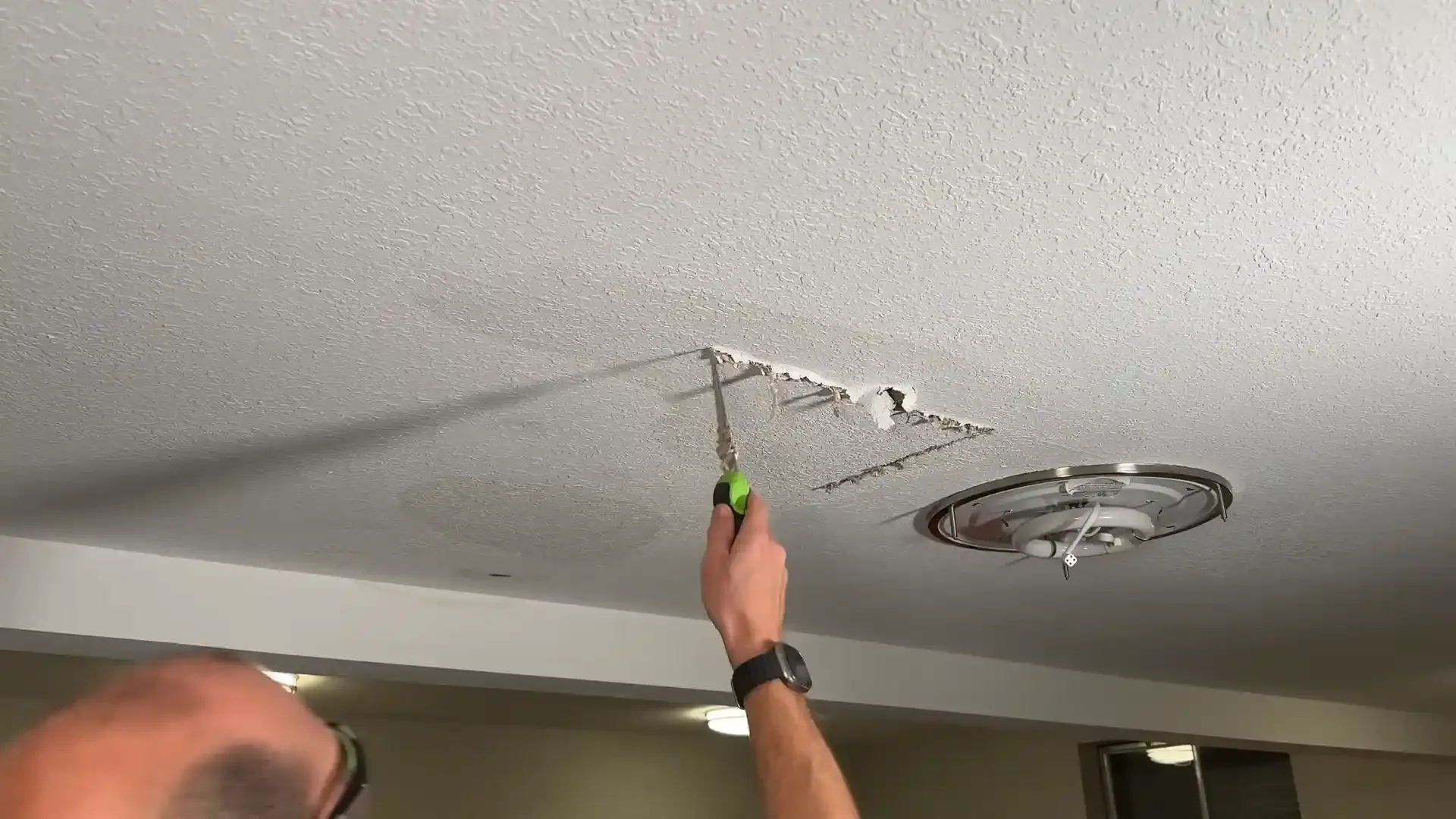
What a Brown Ceiling Stain Actually Tells You
A brown or yellowish stain on a ceiling in a Pueblo County home is water damage, water entered the ceiling finish from above and the dissolved minerals left a stain when the moisture evaporated. What the stain does not tell you is where the water came from. The relationship between stain location and actual source is frequently misleading: water travels along framing members, joists, and insulation before it accumulates at a low point and drips through. The stain may be two, four, or more feet horizontally from the actual entry point.
This migration pattern is why painting over a ceiling stain without finding the source fails. The stain reappears when the next moisture event occurs, sometimes months later, sometimes within days. The only repair that holds is locating the source and stopping the water entry before patching and painting.
Is the Stain Active or Historical?
Press the stain gently with a dry finger. If the drywall feels soft, spongy, or wet, the event is ongoing or very recent, treat it as active and call for detection. If it is firm and the surface is completely dry, you may be looking at a historical stain from a past event. Even a historical stain warrants investigation: the moisture that produced it may still be present in framing and insulation above, promoting mold growth in a space you cannot see.
A stain that has grown since you first noticed it is always active. Compare photographs from different dates if available. Growth in the stain boundary over days or weeks confirms ongoing water entry.
The Two Main Source Categories
Plumbing Source: Most Common in Two-Story Homes
In Pueblo County's two-story homes, concentrated in the historic Bessemer, Highland Park, and Eastwood Heights neighborhoods: a ceiling stain in a first-floor room is most likely a plumbing failure from the floor above. The most common sources in order of frequency are shower pan liner failures (water from the shower penetrates beneath the tile and runs to the subfloor), toilet wax ring failures (wastewater escapes the floor seal with each flush), supply line pinholes in the ceiling joist space, and washing machine drain overflows or hose failures in second-floor laundry installations.
A plumbing-source ceiling stain is not correlated with outdoor weather. It appears or grows regardless of whether it has rained or snowed recently. If the stain appeared or grew during a dry period, it is almost certainly a plumbing source rather than a roof or attic issue.
Run each fixture on the floor above the stain in sequence: shower, toilet flush, sink drain, washing machine, while watching the stain area for changes. If the stain grows or a new drip appears when a specific fixture is used, that fixture or its drain connection is the source to investigate first.
Roof or Attic Source: Single-Story Homes
In single-story Pueblo County homes with attic space above the ceiling, stains can result from roof penetration failures, ice damming during winter cold snaps, HVAC condensate drain overflow, or attic condensation. Roof-source stains correlate with weather events, they appear or expand after rain, heavy snow, or extended cold periods. HVAC condensate overflow is seasonal. It appears in summer when the air conditioner runs continuously, then resolves when the system is turned off.
Call (303) 552-3896 for ceiling leak detection throughout Pueblo County. We locate the source (plumbing or structural) before opening the ceiling.
How to Trace the Water Path From Stain to Source
Water follows the path of least resistance through a building's structure. In a Pueblo County two-story home, a first-floor ceiling stain typically originates from a plumbing event on the floor above, but the drip point and the source point are rarely the same location. Water enters the structure at the failure point, travels along a floor joist or subfloor slope, and accumulates at a low spot before penetrating the ceiling finish. The stain marks the accumulation point, not the entry point.
The diagnostic sequence for tracing a ceiling stain in a Pueblo home starts by identifying what is directly above the stain. In a two-story home: check whether a bathroom, laundry room, or kitchen sits above the affected area. If yes, the plumbing in that room is the first category to test. If the room above is a bedroom or closet with no plumbing, the water traveled laterally and the source is farther from the stain than it appears.
Run each plumbing fixture above the stain in sequence with a helper watching the stain area. Flush the toilet, run the shower for two minutes, run the sink, start a washing machine load. If the stain darkens or a drip appears during a specific fixture's operation, that fixture or its drain connection is the active source. If no fixture event changes the stain, the failure may be a slow supply line pinhole that runs continuously, which requires acoustic detection rather than fixture isolation testing.
When to Call for Professional Ceiling Leak Detection
Professional detection is warranted when fixture isolation testing does not identify the source, when the stain is actively growing, or when the ceiling finish is soft or sagging, indicating significant water accumulation in the cavity above. Acoustic listening equipment and thermal imaging locate in-wall or in-floor failures that cannot be isolated by running fixtures.
In Pueblo County's older two-story homes, Bessemer, Highland Park, Eastwood Heights, the in-wall copper supply lines are 60 to 80 years old. A slow pinhole in a supply run that passes between floors can produce a ceiling stain one floor below the failure point, with no fixture correlation because the leak runs continuously regardless of whether any fixture is in use. Acoustic detection finds it; fixture testing does not. Call (303) 552-3896 for ceiling leak detection throughout Pueblo County. We locate the source before opening the ceiling.
Leak in Your Pueblo County Home?
We pick up 24/7. Detection before demolition, one call, no handoff.
(303) 552-3896. Call Now