
What a Pressure Regulator Valve Does and Why Failure Matters
The pressure regulator valve (PRV, also called a pressure reducing valve)is installed on the main supply line where it enters your Pueblo County home, typically near the main shutoff. Its purpose is to reduce the street-side distribution pressure from the Pueblo Board of Water Works to a safe household operating range, typically 50 to 80 PSI. Street main pressure in Pueblo County distribution zones commonly runs between 80 and 120 PSI, levels that are appropriate for large-diameter main pipes but that damage residential fixture valves, water heaters, and supply pipe connections over time.
The PRV is a mechanical device with internal springs and a diaphragm that wears with years of use. PRVs have a typical service life of 7 to 12 years. When the PRV fails, either passing full street pressure to the interior system, or failing in the closed position and blocking flow: the consequences for the home's plumbing are significant.
Signs of PRV Failure in Pueblo County Homes
A PRV failing in the open position (passing full street pressure)typically goes unnoticed until secondary effects appear. The fixtures that fail first are those with the least pressure tolerance: toilet fill valves that begin running continuously or cycling repeatedly as the float valve cannot seal against high pressure; hot water faucets that drip from the valve seat; and the temperature and pressure relief valve on the water heater, which opens periodically to discharge excess pressure.
In Pueblo County's copper-era mid-century homes in Belmont, Country Club, and Lakeview, a failed PRV accelerates pinhole leak formation. The corrosion mechanism that produces pinholes is pressure-sensitive: higher velocity water at fittings and elbows strips the interior oxide coating faster. A supply system running at 110 PSI instead of 65 PSI produces measurably higher turbulence at every fitting in the house. Homes experiencing their second or third pinhole event within a few years often have a failed PRV contributing to the accelerated failure rate.
A water pressure test is a two-minute check that identifies PRV failure before fixture and pipe damage compounds. If you have not had your supply pressure measured in the past few years, or if you have noticed any of the described symptoms, a pressure reading is the starting point.
PRV Testing and Replacement in Pueblo County
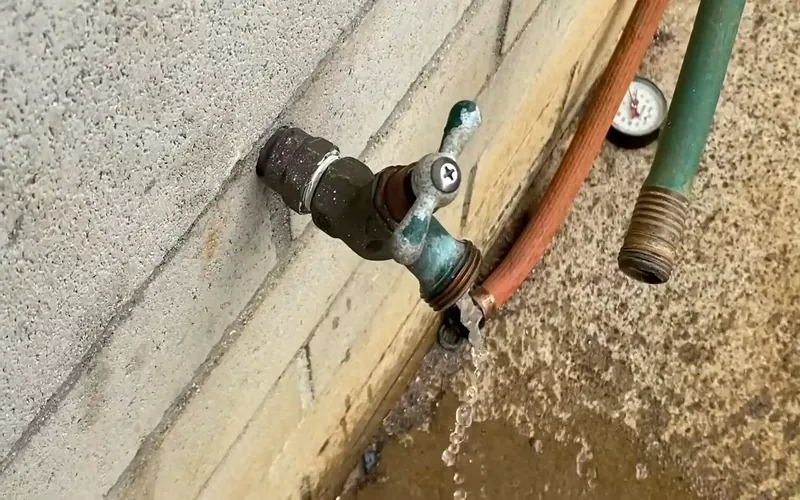
Testing requires a pressure gauge attached to a hose bib: the reading with all fixtures off reflects static supply pressure at that point in the system. A reading consistently above 80 PSI indicates either a failed PRV or an undersized setting. A reading that varies significantly between morning and evening reflects pressure fluctuation in the Pueblo Board of Water Works distribution system that a properly functioning PRV should be buffering.
PRV replacement is a straightforward procedure: the main supply is shut off, the old PRV is removed, and a new PRV is installed with the pressure set to the correct operating range for the home. The replacement PRV is adjusted to confirm the correct downstream pressure before service is restored. For homes where the PRV was installed in an awkward location, common in Pueblo County homes built in the 1960s and 1970s where the PRV may be in a crawlspace or behind a utility panel, access is part of the repair scope. Call (303) 552-3896 for pressure testing and PRV replacement throughout Pueblo County.