
Why Faucet Leaks in Pueblo County Homes Cost More Than They Seem
A single dripping faucet losing one drop per second adds up to roughly 3,000 gallons of wasted water per year. At Pueblo Water billing rates, that is a measurable line item across the year's statements: the kind of incremental loss that homeowners notice in the cumulative bill total without connecting it to a dripping kitchen faucet they've been meaning to address.
In Pueblo County's older housing stock: the historic Bessemer and Mesa Junction neighborhoods, the mid-century Country Club and Lakeview areas, the post-WWII Highland Park and Eastwood Heights homes, faucet fixtures sometimes date to original construction. A faucet installed in 1968 or 1975 has been turning on and off daily for 50-plus years. The internal components: the ceramic disc cartridge in a modern fixture, the rubber seats and washers in an older compression-style faucet, are well past their designed service cycles. Pueblo's moderately hard water at 180 mg/L accelerates the corrosion of the brass seat surfaces that washers seal against.
Faucet Leak Types and What Fails
Compression Faucets: Seats and Washers
Compression-style faucets, common in older Pueblo County homes, recognizable by separate hot and cold handles that you turn clockwise to close, use a rubber washer pressed against a brass seat to stop water flow. The washer compresses against the seat each time the faucet closes; over thousands of cycles, the rubber hardens and the brass seat corrodes. The leak is typically a drip from the spout when the faucet is closed. A new seat washer resolves the drip when the seat is in good condition; a corroded or pitted seat requires reseating or replacement.
Cartridge Faucets: Cartridge and O-Ring Failure
Single-handle faucets and many newer two-handle designs use a cartridge: a sealed unit containing the internal flow control mechanism. Cartridges are designed for replacement when they fail rather than repair. A dripping spout typically means the cartridge's internal seals have worn. A leak from the faucet body around the handle or spout base usually indicates a failed O-ring on the cartridge body or valve seat. Cartridge and O-ring replacement is a straightforward repair when the correct replacement part is identified for the faucet brand and model.
Ball Faucets: Springs, Seats, and O-Rings
Ball-type faucets common in kitchen installations use a rotating ball mechanism with springs, rubber seats, and O-rings. Multiple components can fail simultaneously: a dripping spout often indicates worn springs or seats, while a leak at the handle base indicates failed O-rings on the ball assembly. These faucets typically benefit from a complete repair kit replacement rather than replacing single components.
Identifying the faucet type accurately before repair avoids the common mistake of replacing one component while leaving a co-failed component in place, which produces a callback when the second component fails two months later.
Outdoor and Hose Bib Faucets in Pueblo County
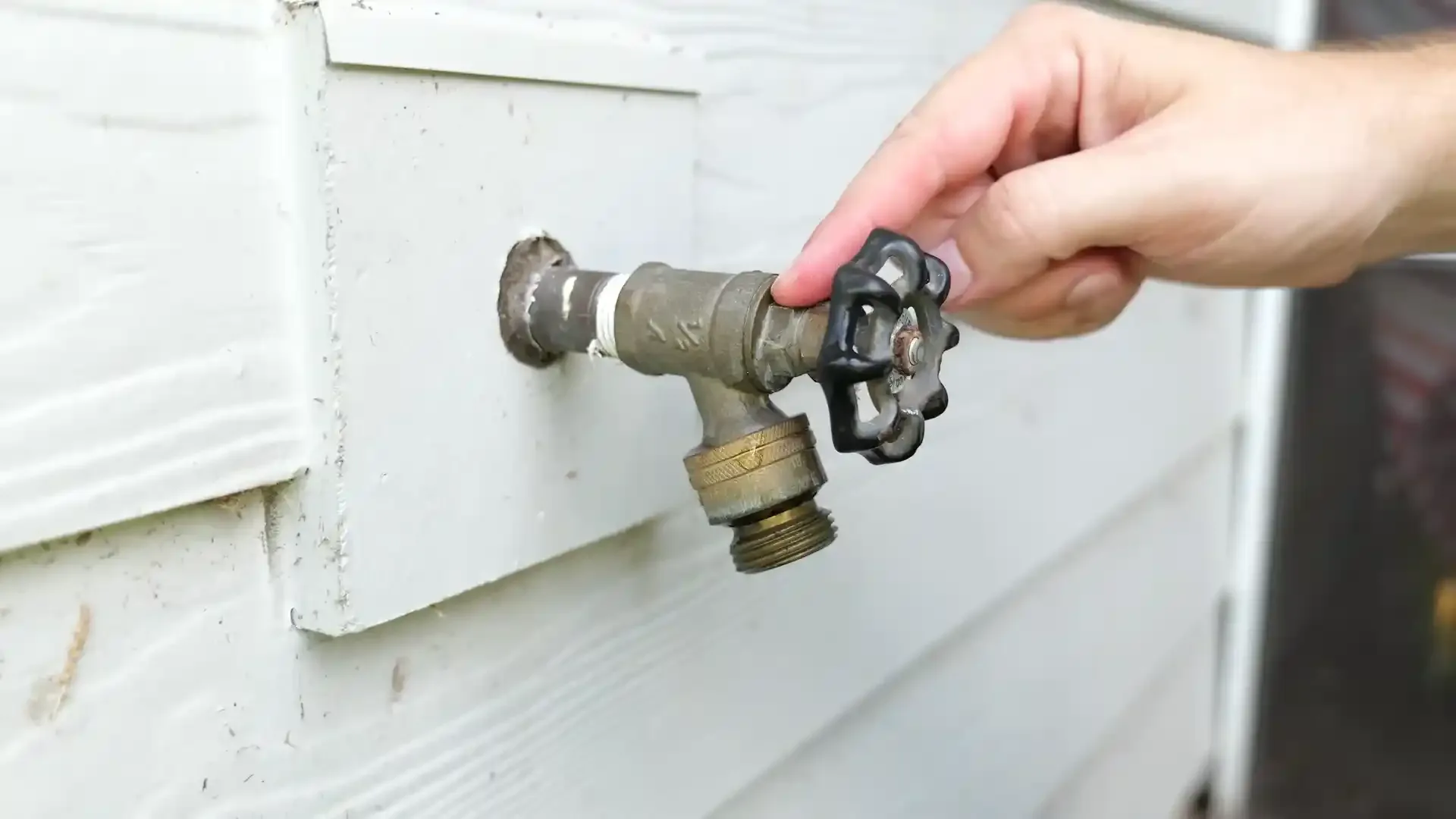
Outdoor hose bibs and frost-free sillcocks in Pueblo County homes deserve particular attention. Pueblo's semi-arid climate masks freeze risk, winter lows regularly reach the teens, and cold snaps drive temperatures to single digits. A hose bib that was not properly drained before freezing, or a frost-free sillcock with a garden hose left attached (which defeats the anti-freeze function), can develop a crack in the body or the interior pipe extension that only becomes apparent when the water is turned on in spring. These failures are not visible from outside; the leak can run inside the wall behind the exterior siding until it is discovered through interior damage. We detect faucet and hose bib failures throughout Pueblo County — call (303) 552-3896 for same-day service.