
The Two Sources of Basement Water in Pueblo County Homes
Pueblo County homeowners with basement water intrusion face the same fundamental diagnostic challenge regardless of neighborhood: determining whether the water is coming from inside the plumbing system or from outside the foundation. The two categories of failure look similar at the floor level, standing water, wet concrete, damaged stored items, but require completely different detection methods and repairs. Applying the wrong fix is not just ineffective; it can delay correct repair by months while the homeowner assumes the problem is resolved.
Category 1: Plumbing-Source Basement Water
A supply line failure, drain connection drip, water heater leak, or drain backup can all produce standing water in a Pueblo County basement. The diagnostic markers for plumbing-source water are consistent presence regardless of weather, association with specific plumbing system events, and active dripping or flow traceable to a pipe or fixture connection.
Supply side failures are confirmed with a pressure test: if the system loses pressure with all fixtures off, an active supply leak exists. Acoustic detection locates the specific pipe. In Pueblo County's older Bessemer and Downtown Pueblo homes where the basement contains original galvanized supply lines from the 1920s through 1950s, a supply pipe failure below grade is a realistic finding, and one that suggests the surrounding pipe run is at a similar corrosion stage.
Drain backups (sewage backing up into a basement floor drain)indicate a blockage or failure in the sewer line downstream. This is a sewage water situation requiring camera inspection of the main sewer line to identify the obstruction or structural failure. In Pueblo County's older neighborhoods where cast iron mains are decades past expected service life, a sewer camera inspection is often the only way to determine whether the backup is from a blockage that can be cleared or from a structural failure that requires excavation and repair.
Sewage water backup in a basement is a sanitary emergency. The affected area requires professional cleaning and disinfection in addition to the plumbing repair. Call (303) 552-3896 immediately if sewage is present in your basement.
Category 2: Structural-Source Basement Water
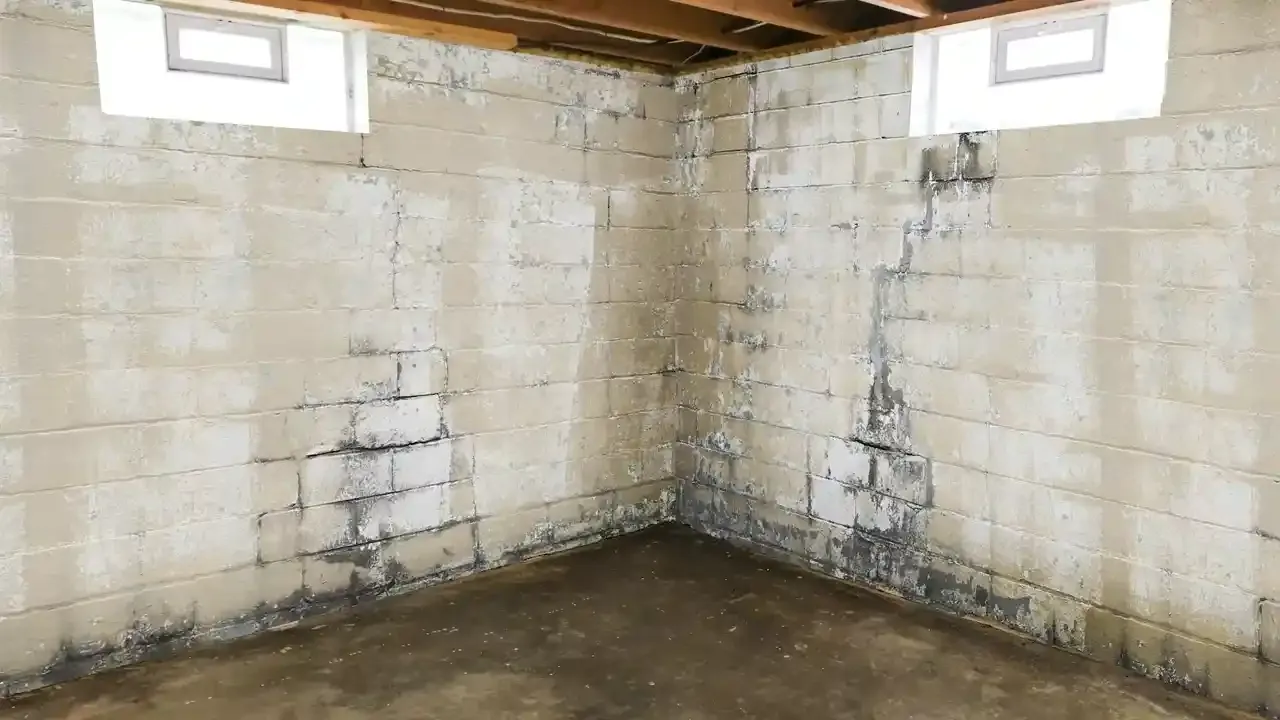
Water entering through foundation wall cracks, floor cracks, or the wall-floor joint (called the cove joint) is structural intrusion driven by hydrostatic pressure from exterior groundwater or surface runoff. The diagnostic markers are weather correlation (the basement is wet after rain or snowmelt)staining patterns on walls that follow gravity (water is running down the wall from a point of entry above), and efflorescence (white mineral deposits left by evaporating water that confirm past or ongoing moisture movement through the concrete or block).
In Pueblo County, the structural intrusion risk is elevated during two distinct seasonal periods. Spring snowmelt from the Sangre de Cristo Mountains and Wet Mountains to the west and south feeds the Arkansas River drainage, raising groundwater in low-lying areas near Fountain Creek and the Arkansas River, which cuts through the heart of the Bessemer, Mesa Junction, and Downtown Pueblo neighborhoods. Late summer monsoon-pattern rainfall events deliver intense precipitation in short periods, concentrating surface runoff against foundations before drainage systems can manage it.
Homes in the Arkansas River flood plain adjacent areas and near Fountain Creek are the most consistently affected. Bessemer and Downtown Pueblo basements that experience annual spring moisture intrusion have been doing so for decades. It is a known condition of the specific microgeography rather than a sign of construction failure. The repair question is how to manage it effectively, which requires correctly diagnosing the specific entry point. Call (303) 552-3896 for basement water detection throughout Pueblo County.