
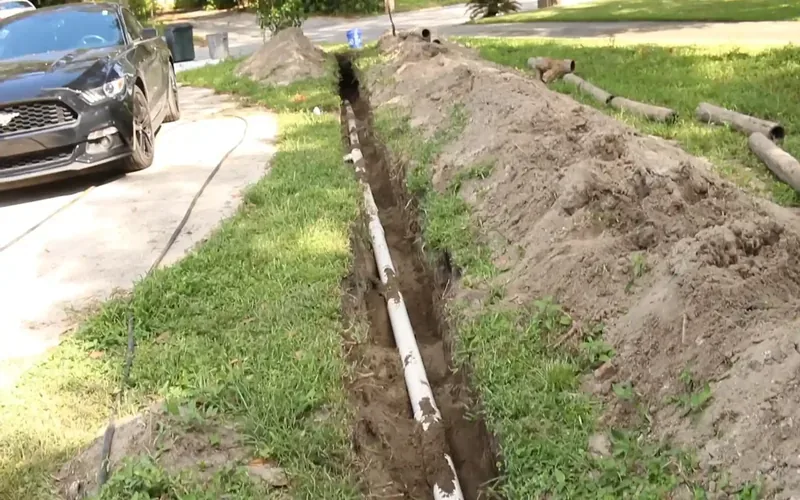
Why Sewer Line Failures Are Easy to Dismiss. Until They Aren't
A sewer line failure in a Pueblo County home announces itself differently than a supply pipe leak. There is no meter movement, no water bill increase, no dripping visible anywhere. The sewer system is a gravity-drain network that carries waste away from the house, when it fails, the first evidence is indirect, and many homeowners live with the early indicators for months before the connection becomes clear.
The cast iron sewer laterals in Bessemer, Mesa Junction, Downtown Pueblo, and Salt Creek are 70 to 100 years old. The ABS and early PVC laterals in Belmont, Lakeview, and Country Club are 40 to 50 years old and subject to root intrusion from the mature landscaping these neighborhoods have developed. Both failure types produce the same five warning signs, and both warrant camera inspection before the situation reaches its late-stage form.
Five Signs Your Pueblo County Home Has a Sewer Line Problem
1. Multiple Slow Drains Simultaneously
A single slow drain (one bathroom sink, one tub)is usually a localized blockage at the fixture trap or the drain arm. When two or more fixtures drain slowly at the same time: the tub is slow, the toilet fills sluggishly after flushing, the kitchen sink backs up: the problem is in the main sewer line that all fixtures drain into. A main line restriction or failure slows flow from everything above it simultaneously.
2. Gurgling from the Toilet When Other Fixtures Run
Sewer lines vent to the atmosphere through the roof vent stack, which prevents vacuum conditions when fixtures drain. When the main line is partially obstructed or has collapsed and partially blocked flow, air is pulled from the toilet bowl as other fixtures drain, producing the characteristic gurgling sound. In a Pueblo County home, gurgling from the toilet when the washing machine drains or when a bathroom sink empties is a reliable indicator of main line involvement, not a toilet problem.
3. A Sewer Smell in the Yard
Hydrogen sulfide (the rotten-egg odor component of sewer gas)migrates upward through soil from any crack or joint failure in a buried sewer lateral. In Pueblo's semi-arid climate, the odor is often more noticeable in the yard than it would be in a wetter environment where soil moisture better contains it. A faint but consistent sewage smell in the yard, particularly in a zone that corresponds to the estimated route of the lateral from house to street, is a direct indicator of an underground sewer failure.
4. An Unusually Green or Wet Zone in the Yard
Sewer lateral failures leak nutrient-rich wastewater into the surrounding soil. In Pueblo's low-rainfall environment, this produces a noticeably greener or more vigorous growth zone in the yard that corresponds to the lateral route. The grass above a leaking sewer line in a Pueblo County yard is often distinctly greener than the surrounding lawn, particularly during the dry summer months when unirrigated grass browns. This pattern is visible without any equipment and is worth noting when you observe it.
5. Sewage Backup in the Lowest Fixture
When a main sewer line is significantly obstructed or has collapsed, the first backup appears at the lowest drain point in the house, typically a basement floor drain, a laundry tub, or the lowest toilet. Sewage backup in any drain fixture is an emergency condition that warrants immediate response. In Bessemer and Downtown Pueblo homes with full basements, sewage backing up into the basement floor drain indicates a main line failure that requires same-day camera inspection and response.
A single backed-up toilet or one slow drain is a localized problem. Multiple signs from the list above, occurring simultaneously or in sequence, indicate a main sewer line failure that will worsen, not resolve on its own. Camera inspection through a cleanout access documents the failure location and condition before repair scope is determined.
Call (303) 552-3896 for sewer line inspection and repair throughout Pueblo County. Camera inspection access is available at most cleanout locations in Bessemer, Mesa Junction, Salt Creek, and throughout the city and adjacent communities.
When sewage has actually backed up into a basement or lowest fixture, the contamination and sanitation cleanup afterward is a specialty of its own, separate from clearing or repairing the line itself. Water Damage Restoration Fairfax VA covers that specific side of the problem for readers dealing with a similar backup in other parts of the country.
Why Pueblo County Sewer Laterals Fail When They Do
The cast iron and clay tile sewer laterals installed in Pueblo County's pre-1970s housing stock were designed for a service life of 50 to 75 years under normal conditions. Many of them are now 60 to 100 years old. The failure modes at this age are predictable: cast iron corrodes from the inside out as the hydrogen sulfide produced by sewage breaks down the iron pipe wall over decades of continuous exposure. Clay tile joints, which were sealed with lead and oakum in older installations, loosen as the joint compound deteriorates and the underlying pipe sections shift slightly with soil movement.
| Symptom | What It Indicates | Urgency | First Diagnostic Step |
|---|---|---|---|
| Sewage smell in yard (no visible wet spot) | Lateral crack or failed joint | High | Camera inspection from cleanout |
| Multiple slow drains throughout house | Main lateral blockage or collapse | High | Camera inspection: root or offsett |
| Gurgling after toilet flush | Partial blockage or venting issue | Medium | Camera: distinguish blockage from structural |
| Wet spot in yard, no rain, no irrigation | Sewer lateral or water line leak | High | Dye test to distinguish sewer vs water |
| Unusually lush grass patch over sewer route | Slow seep from crack fertilizing soil | Medium | Camera inspection: may be early stage |
| Sewage backup in lowest fixture | Full blockage or collapsed pipe | Urgent | Camera immediately, stop use of fixtures |
Cast iron and clay tile laterals in Pueblo's pre-1970 housing stock (Bessemer, Mesa Junction, Downtown, Highland Park) are most prone to structural failure. Camera inspection from the cleanout is the definitive diagnostic — call (303) 552-3896 for same-day response.
Pueblo County's clay soil adds the movement factor that accelerates these failures beyond what age alone would predict. Bentonite clay beneath and around a sewer lateral swells with seasonal moisture and contracts through dry periods. This movement applies lateral force to the pipe at each cycle, accumulating at the weakest points, joints, transitions from cast iron to PVC where repairs have been made, and sections running beneath tree root systems. A joint that was sealed adequately at installation may be pushed open by a combination of 60 years of corrosion and 60 years of seasonal clay movement acting together.
Camera Inspection and What It Actually Shows
Sewer camera inspection passes a flexible cable with a camera head through the lateral from the cleanout access point, typically at the foundation or in the yard between the house and the street main. The camera transmits live video of the pipe interior, revealing cracks, offsets, root intrusion, bellied sections, and grease accumulation. A locator device above ground tracks the camera head position, so the technician can mark the surface location of any defect found.
What camera inspection shows matters as much as what it reveals. A lateral with active root intrusion throughout its length (roots entering at every joint from a large mature tree)is a different situation than a lateral with a single offset joint that is causing pooling. The first may require full lateral replacement; the second may be addressed with targeted repair at the confirmed offset location. Trenchless repair methods (pipe lining and pipe bursting)can restore laterals that have structural integrity issues without full excavation of the yard. For a Pueblo County lateral running under an established lawn or mature landscaping, the trenchless option preserves the yard while addressing the pipe. Call (303) 552-3896 for sewer line camera inspection and detection throughout Pueblo County.
Pueblo County Leak? Call Now.
Acoustic and thermal detection locates it first. Same-day dispatch, 24/7.
(303) 552-3896 — Call Now