
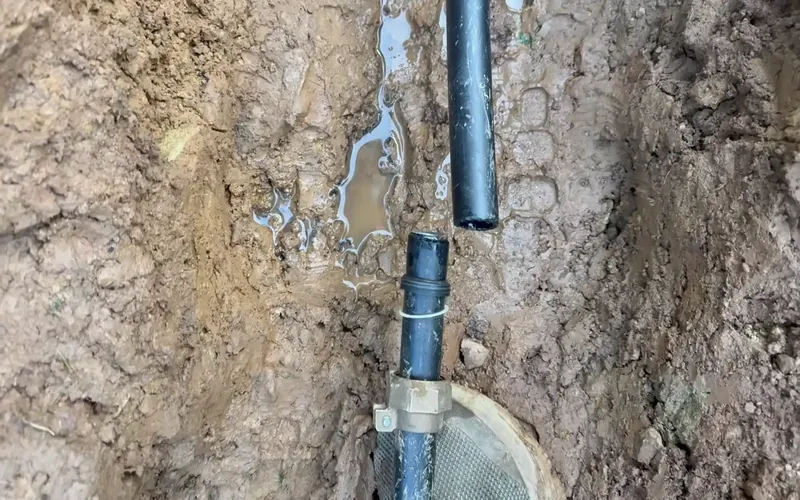
Reading the Yard Surface: What Wet Patches Tell You
In Pueblo County's semi-arid climate, a persistently wet or soft patch of yard stands out immediately: the surrounding soil is typically dry between irrigation cycles, and spontaneous moisture in the absence of recent rain or irrigation is a reliable signal that something is leaking below. The challenge is that the surface expression of a buried pipe leak rarely aligns precisely with the failure point underground.
Water from a buried main line break or irrigation lateral crack migrates through soil along the path of least resistance, following gravel beds, utility trenches, or the boundary between different soil layers before it reaches the surface. In Pueblo County's mixed soil profile (clay-heavy in some neighborhoods,, alluvial sandy near the Arkansas River, caliche-layered in the drier county areas, this migration path can carry surface water several feet, or even tens of feet, from the actual pipe failure. Digging at the wet patch without detection work typically misses the failure on the first attempt.
The character of the surface expression also provides clues. A wet patch that appears directly after irrigation or rain and drains quickly suggests surface drainage concentration rather than a buried leak. A patch that stays soft for days after the last watering and expands slowly over time is more consistent with an underground source that is continuously releasing water into the soil profile.
Identifying the Source: Three Common Yard Leak Causes
Main Water Service Line Break
The service line from the Pueblo Board of Water Works meter to the house foundation runs underground across the yard. A failure anywhere in this run, corroded galvanized pipe in older Bessemer and North Side Pueblo homes, a copper joint failure, or a PVC coupling separation, releasing pressurized water continuously. The meter test confirms this: if the meter moves with all fixtures off and all irrigation valves closed, the main line is the prime suspect. Ground acoustic detection locates the failure before any excavation begins.
Irrigation Lateral or Main Failure
A buried irrigation lateral line crack releases water during every irrigation cycle and continues leaking through the soil between cycles from residual pressure. The wet patch appears or expands after each irrigation run. Zone isolation, running one zone at a time while monitoring the meter flow rate, which identifies contains the failure. Acoustic detection within that zone locates the specific failure point.
Sewer Line Leak
A saturated patch in the yard with a sewage odor points to a sewer line failure rather than a supply line break. The wet zone in this case contains wastewater migrating to the surface. In Pueblo County's older neighborhoods, Bessemer, Mesa Junction, Salt Creek, and North Side, aging cast iron sewer mains can crack and allow sewage to leach into the surrounding yard soil. Camera inspection through a cleanout access confirms the failure location within the sewer line. Call (303) 552-3896 for yard leak detection and repair throughout Pueblo County, including rural properties in Avondale, Boone, and the eastern Pueblo County agricultural areas.